Sacsayhuaman is one of the most extraordinary archaeological sites in Peru and one of the most impressive examples of Inca stonework anywhere in the Andes. Located above Cusco, the enormous complex is famous for its massive stone blocks, enormous zigzag walls, terraces, ceremonial spaces, and panoramic views over the former Inca capital.
For centuries, travelers and historians have been fascinated by the size and precision of its masonry. Some individual stones weigh many tons, yet they were shaped and fitted together with remarkable accuracy. The result is a monument that continues to raise questions about how the Inca transported, shaped, and positioned such enormous blocks without modern machinery.
Although Sacsayhuaman is commonly described as an ancient fortress, its purpose was probably more complex. Archaeological evidence suggests that it served ceremonial, political, military, and religious functions. It formed an important part of the Inca capital of Cusco and was closely connected to the city’s sacred and symbolic landscape.
Today, Sacsayhuaman Cusco is one of the most important places to visit near the city. Its massive walls, archaeological remains, and elevated location make it an essential stop for travelers interested in Inca history, architecture, archaeology, and Andean culture.
What Is Sacsayhuaman?
Sacsayhuaman, also written as Saqsaywaman or Sacsayhuamán, is a large Inca archaeological complex located on a hill above Cusco. The site consists of monumental stone walls, terraces, platforms, ceremonial areas, foundations, and other structures spread across a broad area.
The most famous feature is its series of enormous zigzag walls constructed from precisely cut stones. These walls are the image most commonly associated with Sacsayhuaman, although the complete archaeological complex is considerably larger than the visible walls.
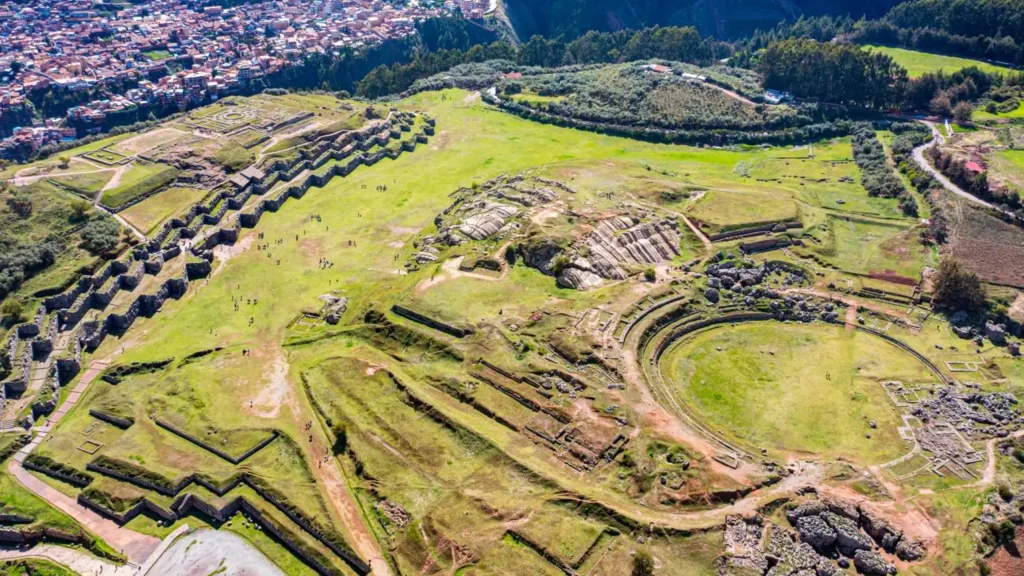
Sacsayhuaman was integrated into the design of the Inca capital. Its elevated position gave it strategic importance, but its scale and ceremonial characteristics indicate that it was not simply a defensive fortress.
Today, the site is one of the most visited archaeological attractions in the Cusco region and an important destination for understanding the engineering achievements of the Inca civilization.
Sacsayhuaman Cusco and Sacsayhuaman Peru
Sacsayhuaman Cusco is located just outside the historic center of Cusco, high above the city. Because of its proximity, the site can be visited during a half-day excursion or combined with a walking route through the historic center.
The archaeological complex is particularly impressive when viewed from below because its huge stone walls rise above the city. From the site itself, visitors can also see extensive portions of Cusco and the surrounding mountains.
Sacsayhuaman Peru is important not only as an archaeological attraction but also as a cultural site. The complex remains associated with important celebrations, especially Inti Raymi, the traditional Festival of the Sun held in Cusco each year.
Its location makes it convenient to combine with other nearby archaeological sites such as Q’enqo, Puka Pukara, and Tambomachay.
Where Is Sacsayhuaman?
Sacsayhuaman is located approximately 2 kilometers north of Cusco’s Plaza de Armas, although the route involves significant uphill terrain.
The complex occupies elevated ground overlooking the city. This position explains why visitors get such extensive views of Cusco and the surrounding Andes.
From the historic center, travelers can reach the site by:
- Walking uphill
- Taking a taxi
- Joining a guided archaeological tour
- Using private transportation
- Combining it with nearby archaeological attractions
Because of the elevation and steep approach, travelers who have just arrived in Cusco may prefer transportation rather than walking all the way from the Plaza de Armas.
Sacsayhuaman Fortress
Sacsayhuaman is often called the Sacsayhuaman Fortress, and this description has become deeply established in tourism literature. The site’s massive walls certainly have defensive characteristics, and its elevated location would have provided an important strategic advantage.
However, describing it exclusively as a fortress oversimplifies the archaeological evidence.
The complex appears to have served multiple functions. Its enormous ceremonial spaces, carefully constructed walls, terraces, and relationship with Cusco suggest that it was also an important religious and political center.
The Inca did not necessarily separate military, political, religious, and ceremonial architecture in the same way modern societies do. A monumental complex could serve several purposes simultaneously.
Was Sacsayhuaman a Fortress?
The defensive interpretation is understandable because the enormous zigzag walls would have been formidable obstacles to attackers. The elevated location also offered visibility over the surrounding landscape.
However, archaeological interpretations increasingly emphasize the broader character of Sacsayhuaman.
The complex likely included:
- Ceremonial spaces
- Religious functions
- Political functions
- Military functions
- Storage areas
- Administrative activities
- Large gathering spaces
- Symbolic architecture connected with the Inca capital
Therefore, Sacsayhuaman fortress is useful as a popular description, but the site is better understood as a monumental Inca complex with multiple functions.
Sacsayhuaman Ruins
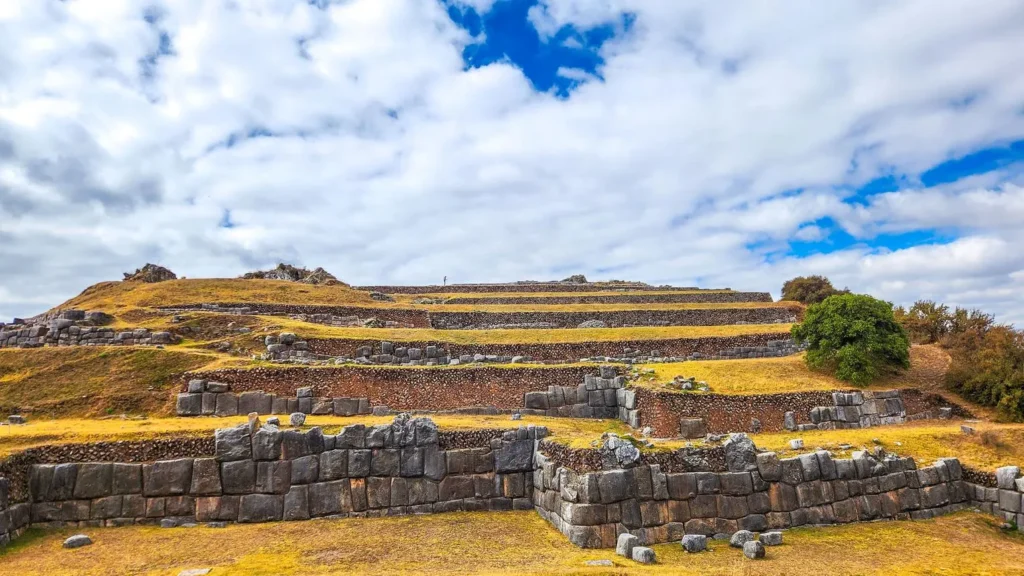
The Sacsayhuaman ruins cover a much larger area than the famous zigzag walls visible in photographs. The complex contains terraces, foundations, platforms, stone structures, ceremonial spaces, and remains of buildings.
Much of the original architecture has disappeared over the centuries, particularly after the Spanish conquest, when stones were removed and reused in colonial construction.
Nevertheless, the surviving walls are extraordinarily impressive.
The Upper Areas
Higher portions of the complex contain archaeological remains associated with structures that once stood above the monumental walls. Visitors can see foundations and open spaces that help illustrate the original scale of the site.
Ceremonial Areas
Large open spaces within Sacsayhuaman were suitable for gatherings and ceremonies. The site’s relationship with Cusco’s sacred landscape reinforces the importance of ritual functions.
Terraces
Terraces helped organize the steep terrain and may have served agricultural, structural, ceremonial, and drainage purposes.
The ruins therefore need to be understood as a complete architectural landscape rather than simply a collection of three stone walls.
Sacsayhuaman History and Builders
The Sacsayhuaman history and builders are closely connected to the expansion of the Inca Empire during the 15th century.
Construction is generally associated with the reign of Pachacuti Inca Yupanqui, the ruler who transformed Cusco into the center of a rapidly expanding empire. Work continued under subsequent Inca rulers and likely involved generations of laborers, architects, engineers, stoneworkers, and specialists.
The project was not completed in a short period. Monumental Inca construction required considerable organization, including quarrying, transporting, shaping, and positioning stones.
Who Built Sacsayhuaman?
So, who built Sacsayhuaman?
The complex was built by the Inca state, rather than by one individual architect or a single small group. Pachacuti is traditionally associated with the transformation and monumentalization of Cusco, while later rulers continued major construction projects.
Thousands of workers were likely involved over extended periods. The Inca Empire had a highly organized labor system that could mobilize large numbers of people for state projects.
These workers included:
- Stonecutters
- Builders
- Engineers
- Quarry workers
- Transport laborers
- Agricultural workers
- General laborers
- Specialized craftsmen
The organization necessary to build Sacsayhuaman demonstrates the administrative power of the Inca state.
The Inca Construction
The Inca construction of Sacsayhuaman reflects several principles characteristic of Andean architecture: massive stone masonry, careful shaping, integration with the natural landscape, strong foundations, and sophisticated management of water and terrain.
The builders did not simply pile enormous stones together. Each block had to be positioned within a larger architectural system.
The irregular shapes of the stones often appear chaotic to modern observers, but the finished walls demonstrate extraordinary planning. Individual stones were shaped so that their surfaces and edges would connect with neighboring blocks.
This approach produced walls that were both visually impressive and structurally stable.
Sacsayhuaman Purpose of the Fortress
The purpose of the fortress remains a subject of discussion because Sacsayhuaman appears to have performed several functions.
Its military potential is obvious. From its elevated location, the complex controlled important approaches to Cusco. The massive walls could also provide defensive positions.
However, its monumental scale and ceremonial spaces suggest additional purposes.
Religious and Ceremonial Functions
Sacsayhuaman was closely connected to the sacred geography of Cusco. The Inca capital itself was designed as a symbolic landscape, and important mountains, temples, roads, and ceremonial locations formed part of a larger sacred system.
The complex’s large open spaces could accommodate gatherings and ceremonies.
Today, its association with Inti Raymi reinforces the site’s enduring ceremonial identity.
Political Importance
A monumental complex of this size also demonstrated the power of the Inca state. Constructing enormous walls visible from the capital would have communicated authority and organizational strength.
Sacsayhuaman therefore represented not only practical architecture but also political power.
Military Role
The site could certainly function defensively. Its walls, elevated position, and strategic location gave it military value.
It is therefore more accurate to say that Sacsayhuaman was a multifunctional monumental complex that included defensive capabilities rather than simply labeling it a fortress.
Sacsayhuaman Stones and Walls
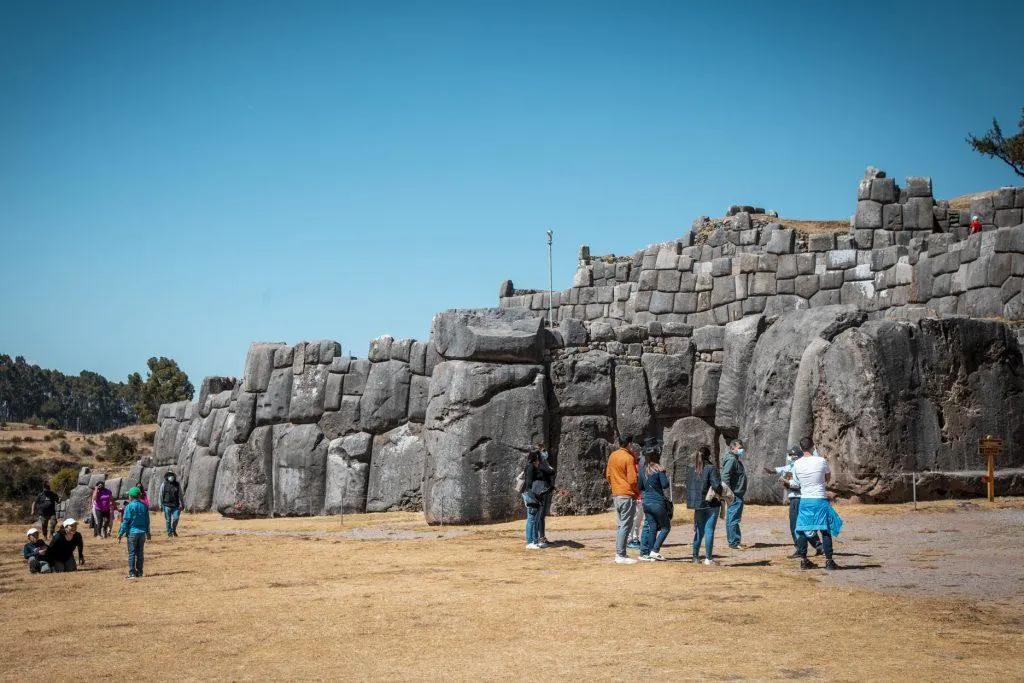
The Sacsayhuaman stones and walls are the defining features of the site. Their enormous size and unusual shapes are responsible for much of the fascination surrounding the ruins.
The largest stones are particularly impressive because of the difficulty involved in moving them through the mountainous landscape.
Massive Stone Blocks
The massive stone blocks at Sacsayhuaman are among the largest examples of Inca masonry.
Some individual blocks are several meters high and weigh many tons. Their irregular forms were deliberately shaped to fit tightly into the wall.
The stones were not standardized rectangular bricks. Instead, many have complex angles and multiple contact surfaces.
This approach provided exceptional stability.
Why Are the Stones So Large?
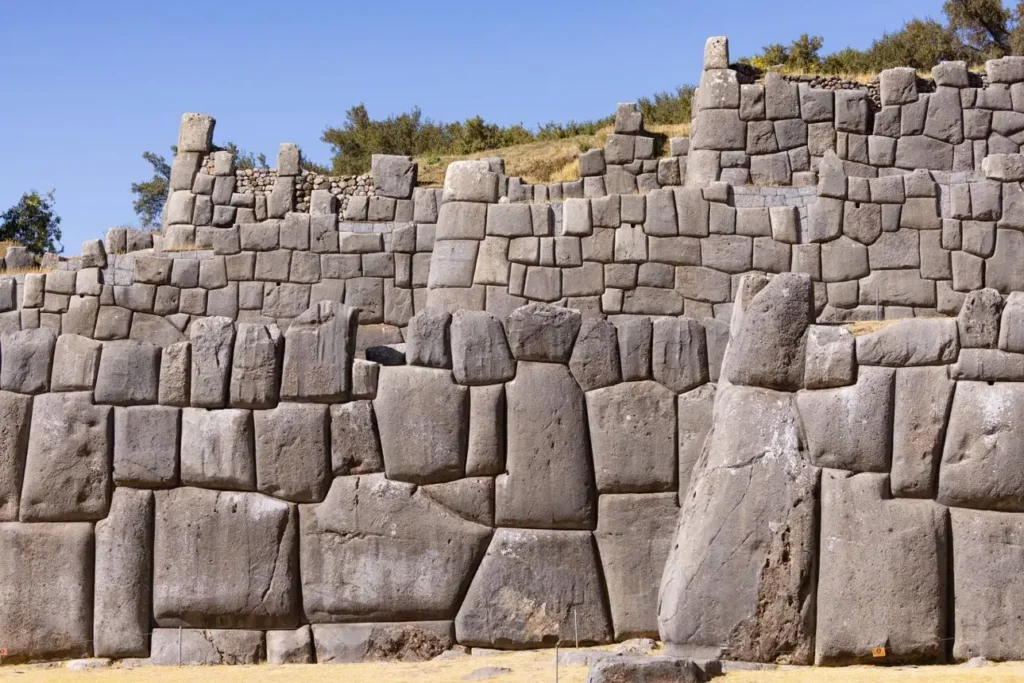
The enormous stones served several architectural purposes. Their mass created extremely strong walls, while their carefully fitted joints reduced the vulnerability of the structure to movement.
The irregular geometry also allowed the builders to distribute pressure across multiple surfaces.
The result is a type of masonry capable of surviving centuries of earthquakes and other environmental stresses.
The Zigzag Walls
The zigzag walls are the most recognizable feature of Sacsayhuaman. Three major defensive-style walls extend across the hillside in a distinctive sawtooth pattern.
The exact symbolic and practical meaning of this design remains debated.
From an architectural perspective, the repeated angles created a complex wall system with projecting and recessed sections. From a symbolic perspective, the zigzag form may have had connections with Andean cosmology and the sacred landscape.
The walls also created multiple defensive angles, allowing defenders to observe and potentially respond to movement from different directions.
Why Are the Walls Zigzagged?
There is no single universally accepted explanation.
Possible interpretations include:
- Defensive advantages
- Symbolic representations
- Integration with the natural terrain
- Structural organization
- Religious or cosmological meaning
The most likely explanation may involve several factors rather than one purpose.
The Inca frequently combined practical engineering with symbolic design, meaning a structure could be both functional and sacred.
Inca Stonework
Inca stonework is one of the defining achievements of Andean architecture, and Sacsayhuaman provides perhaps the most dramatic example.
The builders used different levels of masonry depending on the importance and function of each structure. Some walls consist of finely fitted polygonal blocks, while other areas use smaller and more regular stones.
The most monumental walls required extraordinary precision.
Polygonal Masonry
Polygonal masonry involves fitting stones of different shapes together rather than using uniform rectangular blocks.
At Sacsayhuaman, some stones have multiple sides and irregular outlines. The joints between them can be extremely narrow.
This construction technique distributes pressure through the wall and allows individual stones to move slightly during earthquakes without causing the entire structure to collapse.
Earthquake Resistance
Cusco is located in a seismically active region, so earthquake resistance was particularly important.
Inca walls commonly feature:
- Slightly inclined walls
- Broad foundations
- Tapering construction
- Irregular polygonal stones
- Tight-fitting joints
- Multiple contact surfaces
These characteristics contributed to the remarkable survival of Inca masonry through numerous earthquakes.
How Was Sacsayhuaman Built?
The question how was Sacsayhuaman built continues to attract enormous interest. The basic principles are understood, but many details remain uncertain because the Inca left no written engineering manual describing the entire construction process.
Archaeologists and engineers have reconstructed likely techniques based on surviving structures, quarry evidence, experimental archaeology, and knowledge of traditional Andean construction.
The process would have involved several stages.
Quarrying the Stones
The first stage was obtaining suitable stone. Different types of rock were quarried from locations around the Cusco region.
Workers had to identify large blocks, separate them from the bedrock, and prepare them for transport.
Transporting the Stones
Moving enormous blocks across mountainous terrain was a major logistical challenge.
The Inca did not have wheeled vehicles for heavy transport or modern cranes. Instead, they could use large teams of workers, ropes, wooden supports, prepared paths, ramps, and controlled movement techniques.
The exact methods probably varied depending on the size and shape of each block.
Shaping the Stones
Once a stone reached the construction area, workers shaped it using harder stone tools and other available techniques.
Rather than shaping every block into a regular rectangle, the builders created complex surfaces designed to fit neighboring stones.
Positioning the Stones
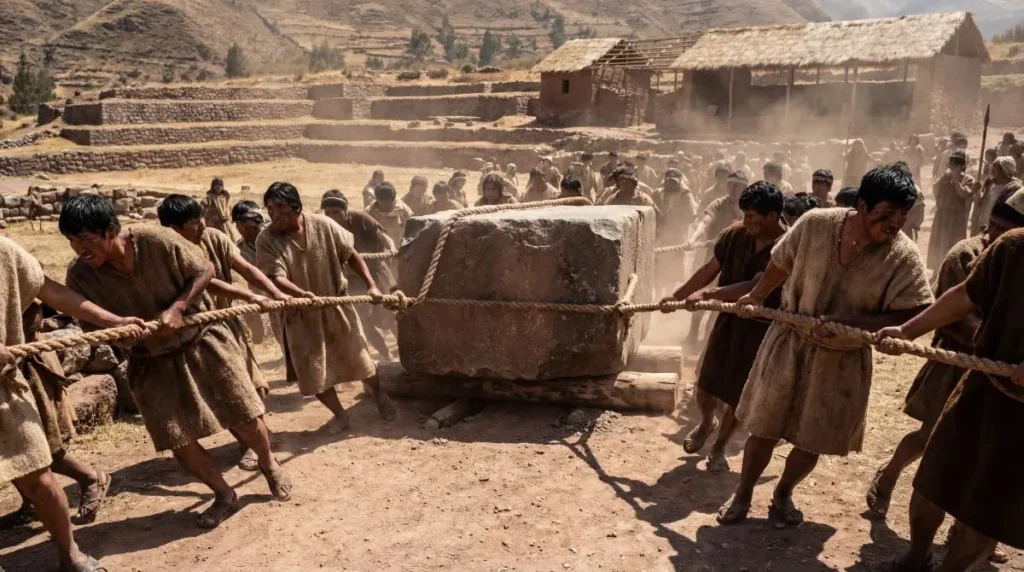
The final stage required carefully maneuvering each block into position.
Large stones could potentially be moved incrementally using levers, ramps, ropes, and coordinated labor.
The precision of the finished wall indicates that this process was extremely controlled.
Construction Techniques
Several construction techniques help explain the extraordinary durability of Sacsayhuaman.
Massive Foundations
The largest walls have enormous foundations capable of supporting substantial weight. The builders understood how to distribute pressure across the terrain.
Carefully Fitted Joints
Instead of relying on mortar, many Inca walls rely on the precise shape and weight of the stones themselves.
Sloping Walls
Inca walls frequently lean slightly inward as they rise. This improves stability and reduces the risk of collapse during seismic movement.
Terracing
Terraces helped adapt the architecture to the steep hillside and provided controlled surfaces for construction.
Integration With the Landscape
The Inca did not treat the mountain as an obstacle. They incorporated the natural contours of the terrain into their design.
This is one of the most important characteristics of Inca architecture: the boundary between natural landscape and constructed environment can be remarkably difficult to define.
The Mystery of the Stones
The mystery of the stones is one of the most popular subjects associated with Sacsayhuaman.
How could people without modern machinery move stones weighing many tons?
The answer is not necessarily supernatural or impossible. The Inca possessed sophisticated engineering knowledge, enormous labor resources, and generations of experience working with stone.
However, the precise process used for every individual block is not completely documented.
The mystery remains because:
- Written construction records are limited.
- Many original construction areas have disappeared.
- Some stones are exceptionally large.
- The terrain around the site is difficult.
- The precise sequence used to position individual blocks is uncertain.
What is clear is that the achievement required remarkable organization.
Did the Inca Use Advanced Machinery?
There is no evidence that the Inca possessed modern lifting machinery comparable to cranes or heavy construction equipment.
Instead, the construction likely depended on human labor, ropes, levers, ramps, sled-like systems, prepared surfaces, and careful engineering.
The most impressive element may therefore not be a mysterious technology, but the ability of the Inca state to organize large-scale labor and apply sophisticated practical knowledge over many years.
Sacsayhuaman Map, Location and Altitude
The Sacsayhuaman map, location and altitude are important when planning a visit because the archaeological complex sits significantly higher than Cusco’s central district.
Sacsayhuaman is located north of the historic center on a prominent hillside.
Sacsayhuaman Altitude
Sacsayhuaman is approximately 3,700 meters above sea level, placing it several hundred meters higher than the Plaza de Armas.
This difference matters because visitors already adjusting to Cusco’s elevation may notice that walking around the archaeological complex is more physically demanding.
The terrain includes stairs, slopes, uneven surfaces, and open areas.
What to Expect at High Altitude
Visitors should:
- Walk at a comfortable pace.
- Drink enough water.
- Avoid unnecessary exertion.
- Take breaks.
- Wear comfortable shoes.
- Protect themselves from strong Andean sunlight.
- Allow time to acclimatize before strenuous sightseeing.
For travelers who have just arrived in Cusco, taking transportation to Sacsayhuaman can be easier than walking uphill from the city center.
What Does Sacsayhuaman Mean?
What does Sacsayhuaman mean? is a question without one completely settled answer because the historical spelling and interpretation of the name have been debated.
The name is generally derived from Quechua and is often interpreted in connection with a falcon or bird. Popular explanations sometimes translate Sacsayhuaman as “satisfied falcon” or associate the site with a falcon-like form.
However, the exact historical meaning is more complicated than a simple modern translation.
Different spellings and colonial transcriptions of Quechua names have contributed to uncertainty. Travelers may therefore encounter Saqsaywaman, Sacsayhuamán, or Sacsayhuaman.
Rather than focusing exclusively on a literal translation, it is more useful to understand the name as the traditional Quechua name of this monumental complex overlooking Cusco.
Sacsayhuaman and Inti Raymi
Sacsayhuaman has an important connection with Inti Raymi, the Festival of the Sun celebrated in Cusco.
The modern festival takes place around the winter solstice in June and incorporates traditional Andean symbolism, ceremonies, costumes, music, and performances.
Sacsayhuaman provides the dramatic setting for the principal outdoor portion of the celebration.
The connection is particularly meaningful because the original Inca Empire placed great importance on solar worship and ceremonial architecture.
Visitors who travel to Cusco around the June festivities may see Sacsayhuaman transformed into a major cultural gathering place.
How to Visit Sacsayhuaman
Knowing how to visit Sacsayhuaman is important because the site can be incorporated into several different types of Cusco itineraries.
From Cusco City Center
The archaeological complex is close enough to the historic center for visitors to walk there, but the route is uphill and physically demanding.
A taxi is a practical alternative, particularly for travelers still acclimatizing to altitude.
By Guided Tour
Many visitors choose an archaeological tour combining Sacsayhuaman with nearby attractions.
A typical route may include:
- Sacsayhuaman
- Q’enko
- Puka Pukara
- Tambomachay
This allows travelers to see several Inca sites in one excursion.
On a Private Tour
A private tour can provide more flexibility. Travelers can spend additional time photographing the stone walls, asking questions about construction, or moving at a slower pace.
This can be particularly useful for families, photographers, and visitors who are still adjusting to Cusco’s altitude.
Best Time to Visit Sacsayhuaman
Sacsayhuaman can be visited throughout the year, but weather conditions influence the experience.
The dry season generally provides better conditions for walking and photography, with clearer skies and less frequent rain. The rainy season can produce dramatic clouds and greener landscapes, although trails and stone surfaces can become slippery.
Early morning is often a good time for quieter conditions and photography. Late afternoon can provide beautiful light across the walls and the city below.
Travelers should remember that the high-altitude sun can be intense even when the air feels cool.
What to Bring to Sacsayhuaman
Because the archaeological site involves walking across uneven and exposed terrain, appropriate clothing and equipment can make the visit more comfortable.
Consider bringing:
- Comfortable walking shoes
- Water
- Sun protection
- Hat or cap
- Sunglasses
- Light layers
- Rain protection during wet weather
- Camera or smartphone
- Small backpack
- Identification and necessary entrance documentation
Avoid carrying unnecessary heavy luggage because the combination of altitude and uneven terrain can make walking more tiring.
Why Sacsayhuaman Is Important
Sacsayhuaman is important because it demonstrates the extraordinary engineering, organization, and cultural sophistication of the Inca civilization.
Its importance can be understood through several dimensions.
Architectural Importance
The stonework represents one of the highest achievements of Inca masonry.
Historical Importance
The site was closely connected with the development of Cusco as the capital of the Inca Empire.
Cultural Importance
Sacsayhuaman remains connected to Andean traditions and major cultural celebrations such as Inti Raymi.
Engineering Importance
The construction demonstrates how the Inca adapted enormous stone architecture to a mountainous and earthquake-prone environment.
Symbolic Importance
Its location above Cusco and its relationship with the city’s sacred landscape demonstrate that Inca architecture was closely connected with political and religious ideas.
Sacsayhuaman vs. Machu Picchu
Sacsayhuaman and Machu Picchu are both major Inca destinations, but they offer very different experiences.
Machu Picchu is a complete mountain citadel surrounded by spectacular natural scenery, while Sacsayhuaman is a monumental complex integrated directly into the landscape above Cusco.
Sacsayhuaman is particularly valuable for travelers interested in:
- Inca engineering
- Massive stonework
- Ancient construction techniques
- Cusco’s history
- Ceremonial architecture
- Archaeology
- Panoramic city views
One of the biggest advantages of Sacsayhuaman is accessibility. It can be visited during a short excursion from Cusco, making it an excellent complement to a Machu Picchu journey.
Final Guide to Sacsayhuaman
Sacsayhuaman is far more than a collection of enormous stones above Cusco. It is one of the greatest surviving examples of Inca monumental architecture and an essential place for understanding the history of the Inca capital.
The Sacsayhuaman ruins reveal a civilization capable of organizing immense construction projects, transporting massive stones, shaping complex masonry, and adapting monumental architecture to a difficult mountainous environment.
The famous zigzag walls are its most recognizable feature, but the complete archaeological complex includes terraces, ceremonial spaces, foundations, platforms, and other structures. Its original purpose appears to have extended beyond simple military defense, incorporating ceremonial, religious, political, and strategic functions.
The question of who built Sacsayhuaman can be answered broadly: it was constructed by the Inca state over generations, particularly during and after the reign of Pachacuti. Thousands of workers and specialists likely participated in the project.
The exact techniques used to move and position every massive stone remain incompletely documented, but there is no need to attribute the construction to mysterious technology. The evidence points toward sophisticated engineering, careful planning, skilled stonework, organized labor, and an enormous investment of time and resources.
For visitors to Cusco, Sacsayhuaman is one of the easiest ways to encounter the monumental scale of Inca architecture. Its proximity to the city, extraordinary stone walls, cultural importance, and panoramic views make it an essential stop for anyone interested in Sacsayhuaman Peru, Inca history, archaeology, or the remarkable engineering achievements of the Andes.
Leave a Reply