Puka Pukara Cusco is one of the most interesting archaeological sites on the hills surrounding the ancient Inca capital. Often translated as the “Red Fortress,” Puka Pukara combines stone terraces, walls, enclosures, pathways, and elevated viewpoints with impressive scenery across the Andes. Although the site is traditionally described as a fortress, its actual role appears to have been broader, involving travel, administration, surveillance, lodging, and control of an important route approaching Cusco.
Located about 7 kilometers northeast of the historic center of Cusco, Puka Pukara Peru forms part of the group of archaeological attractions commonly visited during the Cusco archaeological circuit. Its elevated position, relatively accessible location, and proximity to Qenqo, Sacsayhuaman, and Tambomachay make it an easy addition to a day of exploring Inca heritage.
For travelers interested in Inca architecture, history, and the landscapes surrounding Cusco, Puka Pukara offers something different from the enormous stonework of Sacsayhuaman or the water architecture of Tambomachay. Here, the attraction lies in understanding how the Incas organized movement, observation, accommodation, and communication around their capital.
What Is Puka Pukara?
Puka Pukara is an archaeological complex built on an elevated hillside near Cusco. The site consists of several interconnected structures constructed primarily from stone, including terraces, walls, rooms, platforms, pathways, and enclosed spaces.
Rather than thinking of Puka Pukara simply as a military fortress, it is more useful to see it as a multifunctional Inca complex. Its strategic position allowed people stationed there to observe roads and surrounding valleys, while its architectural spaces could accommodate travelers, officials, guards, or members of an imperial entourage.
The location was particularly important because routes leaving Cusco toward the northeast connected the imperial capital with the Sacred Valley and territories farther into the Andes. Puka Pukara therefore formed part of a larger system of roads, settlements, ceremonial places, and administrative centers that supported the Inca state.
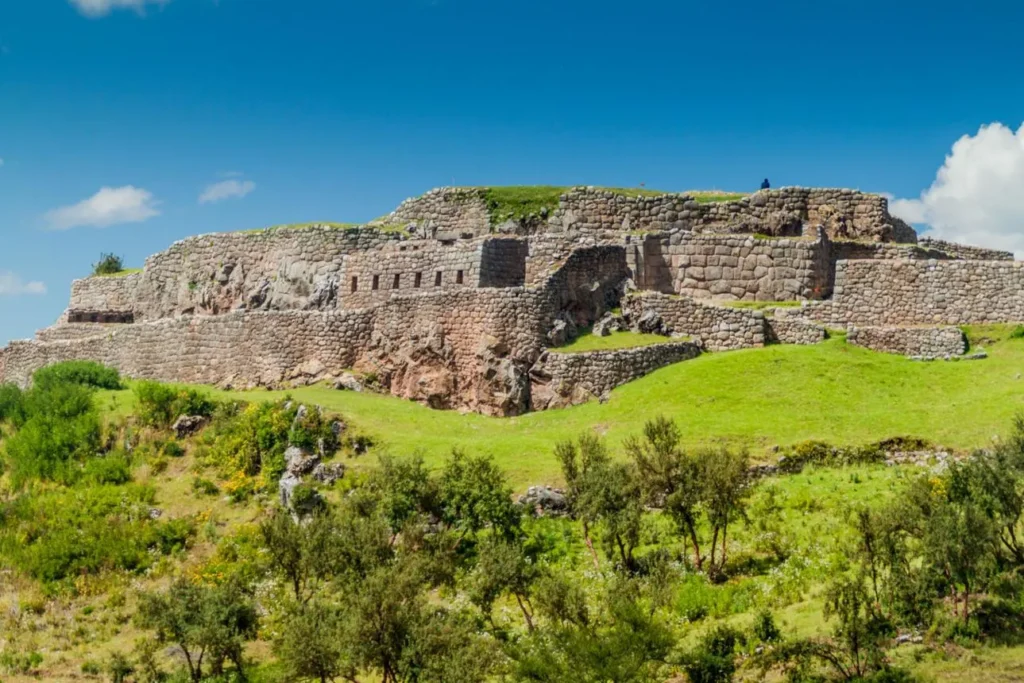
Puka Pukara Cusco and Puka Pukara Peru
The names Puka Pukara Cusco, Puka Pukara Peru, and Puca Pucara are commonly used to refer to the same archaeological site. Spelling varies because Quechua words can be represented in different ways when written with the Latin alphabet.
For travelers searching for Puka Pukara Cusco, the destination they are looking for is the Inca archaeological complex located northeast of the city. It should not be confused with Pucará in the Puno region, which is associated with the earlier Pukara culture.
The Cusco site belongs to the landscape of the former Inca capital and is closely connected geographically and historically with other important archaeological sites in the area.
Location and Importance
Puka Pukara’s importance comes largely from its position. The Incas did not build important complexes randomly; location was fundamental to administration, transportation, defense, agriculture, religion, and communication.
From Puka Pukara, the surrounding landscape opens toward valleys, hills, and routes leading away from Cusco. Its elevated position would have made it useful for observing movement along the road and coordinating activity in the area.
Its importance can be understood through several characteristics:
- Strategic position above an important route.
- Elevated viewpoints over the surrounding landscape.
- Connection with the road network of the Inca Empire.
- Proximity to Tambomachay.
- Relationship with the broader Sacsayhuaman archaeological area.
- Architectural spaces suitable for several practical functions.
- Evidence of the sophisticated organization of Inca settlements.
Puka Pukara History
The Puka Pukara history is connected with the expansion and organization of the Inca state around Cusco. Although the precise date of its original construction and the identity of its principal builder are not established with complete certainty, the visible architecture is generally associated with the Inca period.
Like many archaeological sites in the Cusco region, Puka Pukara should not be understood as an isolated monument. It was part of a much larger cultural landscape in which roads, agricultural areas, settlements, ceremonial sites, storage facilities, and administrative centers worked together.
Historical Background
The area around Cusco was transformed dramatically as the Inca state expanded. Cusco developed from a regional center into the political and administrative heart of an empire that eventually extended across much of western South America.
This expansion required an enormous logistical system. People, food, officials, soldiers, messengers, and goods had to move efficiently across mountainous terrain. Roads were therefore accompanied by facilities that supported travelers and maintained imperial control.
Puka Pukara appears to fit within this broader system. Its architecture and position suggest that it was not merely a defensive structure but a place where practical activities connected with travel and administration could take place.
Puka Pukara During the Inca Period
During the Inca period, the area surrounding Cusco contained an interconnected network of important sites. Sacsayhuaman occupied a dominant position above the capital, while Qenqo had strong ceremonial associations and Tambomachay was closely connected with water and ritual activity.
Puka Pukara occupied a different but complementary position. Its elevated location and proximity to an important route made it suitable for monitoring movement and supporting people traveling through the area.
The site may have functioned as a tambo, or resting and service station, particularly for travelers and groups moving along the Inca road system. Some interpretations also associate it with military or administrative activities. Because archaeological evidence does not always reveal a single purpose, it is more accurate to describe Puka Pukara as a multifunctional complex.
Role of the Archaeological Complex
The role of Puka Pukara likely changed or overlapped depending on the needs of the Inca administration.
Possible activities included:
- Monitoring roads and surrounding approaches.
- Providing temporary accommodation for travelers.
- Supporting officials and groups moving through the region.
- Controlling or supervising movement along an important route.
- Providing space for storage and logistical activities.
- Serving personnel associated with nearby sites.
- Participating in the broader administrative organization of Cusco.
This multifunctional character is one of the reasons Puka Pukara is so valuable for understanding the Inca Empire. The site demonstrates that Inca architecture was not limited to temples and spectacular royal monuments. Many complexes were designed to keep the empire functioning on a daily basis.
What Does Puka Pukara Mean?
One of the most frequently searched questions about the site is “What does Puka Pukara mean?”
The Quechua name Puka Pukara is generally translated as “Red Fortress.” The word puka means red, while pukara refers to a fortress or fortified place.
The name is particularly appropriate when looking at the stonework under certain lighting conditions.
Meaning of the Name
The name reflects the reddish or warm appearance that some of the site’s stones can take on. The effect becomes especially noticeable when sunlight strikes the walls and terraces from a low angle.
However, the name should not be interpreted as proof that the site was exclusively a military fortress. Modern descriptions frequently use “Red Fortress” because it is an established translation, while archaeological interpretations recognize that Puka Pukara probably had several functions.
Why Is Puka Pukara Associated With a Reddish Appearance?
The reddish appearance comes from the color and weathering of the local stone combined with natural light. Depending on the season, weather, and time of day, the walls can appear gray, brown, golden, or reddish.
This is why photographs of Puka Pukara can look surprisingly different from one another.
The color is particularly attractive during late afternoon, when warm sunlight emphasizes the texture of the stone walls and contrasts with the surrounding golden grasses and green vegetation.
Puka Pukara Archaeological Complex
The Puka Pukara Archaeological Complex is characterized by an arrangement of stone structures adapted to the natural slope of the hillside. Instead of creating a completely artificial platform, Inca builders incorporated the existing terrain into the architectural design.
This approach can be seen throughout the Cusco region. The Incas were exceptionally skilled at combining architecture with difficult Andean landscapes, using terraces, retaining walls, stairs, and platforms to create functional spaces on uneven ground.
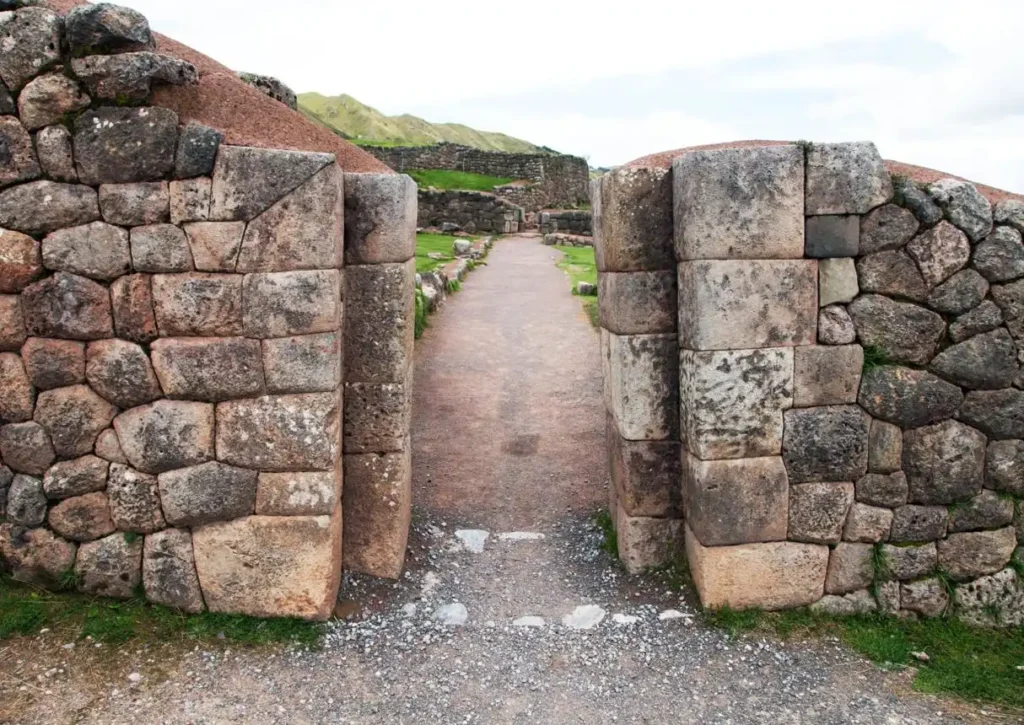
Main Structures
The surviving remains include several types of architectural elements rather than one enormous central building.
Visitors can identify:
- Stone enclosure walls.
- Terraces and platforms.
- Small and medium-sized rooms.
- Passageways.
- Stairways and changes in level.
- Open spaces and plazas.
- Elevated areas that provide broad views.
- Remains associated with water management.
- Structures interpreted as lookout or control areas.
The different components demonstrate that Puka Pukara was carefully organized despite appearing relatively compact compared with larger archaeological complexes.
Stone Terraces and Walls
The terraces are among the most recognizable features of Puka Pukara. They follow the contours of the hillside and help organize the site into different levels.
Terracing had several advantages in the Andes. It allowed builders to stabilize slopes, create usable surfaces, and establish clear divisions between architectural spaces. At Puka Pukara, terraces also contribute to the site’s defensive and strategic appearance.
The walls are constructed with stonework that is functional and durable rather than as highly polished as some of the finest masonry found at royal Inca sites.
This difference is important. Inca architecture was not uniform. The level of stone finishing often reflected the purpose and importance of a structure. Puka Pukara’s practical character is visible in its masonry.
Architectural Features
One of the most interesting aspects of Puka Pukara is the way the architecture interacts with the landscape.
Rather than hiding the natural hillside, the complex uses it. Walls rise from the slope, terraces create horizontal platforms, and pathways connect different levels.
The result is an archaeological site that feels integrated into the surrounding mountains.
Visitors should take time to look beyond the individual stones. The overall layout provides clues about how people moved through the complex and how different spaces may have been connected.
Practical Rather Than Monumental Architecture
Puka Pukara does not have the enormous polygonal blocks associated with Sacsayhuaman. Its architecture is generally more modest and practical.
That does not make it less important. In fact, the contrast helps explain the different functions of Inca architecture. A military, logistical, or administrative station did not necessarily require the same monumental construction as a major ceremonial or royal complex.
Possible Functions of the Site
Archaeologists and historians have proposed several possible functions for Puka Pukara.
The most commonly discussed interpretations include:
- Military or defensive station – Its position allowed observation of routes and surrounding terrain.
- Road control point – Its location near an important route made it useful for monitoring travelers and movement.
- Tambo or resting station – Some spaces may have accommodated travelers or members of official groups.
- Administrative center – The complex could have supported the organization of local resources and transportation.
- Lodging and logistical support – Personnel associated with the Inca state may have used the site during journeys.
Rather than selecting only one of these explanations, it is reasonable to understand Puka Pukara as a multifunctional facility within the Inca transportation and administrative network.
Puka Pukara Location and Altitude
One of the most important practical questions for travelers is where is Puka Pukara?
Puka Pukara is located approximately 7 kilometers northeast of the historic center of Cusco, along the road that continues toward the Sacred Valley and Pisac. The archaeological site sits within the broader landscape associated with the Sacsayhuaman Archaeological Park.
The site is situated at roughly 3,700 meters above sea level, although figures vary somewhat depending on the point used for measurement. This means that visitors should consider the altitude when planning their visit.
Where Is Puka Pukara?
From central Cusco, Puka Pukara is reached by traveling uphill and northeast toward the archaeological sites above the city.
Its position makes it particularly convenient for travelers who want to combine several attractions in a single excursion.
The route commonly connects:
Cusco → Sacsayhuaman → Qenqo → Puka Pukara → Tambomachay
The exact order can vary depending on the tour or transportation arrangement.
Puka Pukara Ubicación
For visitors searching for Puka Pukara ubicación, the most useful point of reference is its position on the road toward Pisac and the Sacred Valley, northeast of Cusco.
The site is easy to recognize because the archaeological remains are located directly beside the route, with stone walls extending across the hillside.
Puka Pukara Altitude and Puka Pukara Altura
The Puka Pukara altitude is approximately 3,700 meters (12,140 feet) above sea level. You may also see slightly different figures in travel information because measurements vary according to the specific point being referenced.
The Puka Pukara altura is therefore significant for visitors who have just arrived in Cusco or who are not yet accustomed to high altitude.
If you are acclimatizing, walk slowly and allow yourself time to enjoy the site rather than rushing between structures.
Puka Pukara and the Cusco Archaeological Circuit
Puka Pukara is one of the easiest archaeological sites to combine with other attractions around Cusco.
The traditional archaeological circuit often includes four major sites:
- Sacsayhuaman.
- Qenqo.
- Puka Pukara.
- Tambomachay.
Each one provides a different perspective on Inca civilization.
Puka Pukara and Qenqo
Puka Pukara and Qenqo are frequently visited on the same tour, although they represent different types of archaeological spaces.
Qenqo is particularly associated with ceremonial and ritual features, including carved rock surfaces, channels, chambers, and unusual stone formations. Puka Pukara, by contrast, has a more practical and strategic architectural appearance.
Visiting both sites provides a useful comparison. Qenqo helps explain aspects of Inca ritual and sacred landscapes, while Puka Pukara illustrates the administrative, logistical, and strategic organization of the region.
Puka Pukara and Tambomachay
The relationship between Puka Pukara and Tambomachay is particularly interesting because the two sites are extremely close to each other.
Tambomachay is strongly associated with water, fountains, channels, and ceremonial activity. Puka Pukara has a more defensive and logistical character.
Their proximity suggests that these locations formed part of a coordinated landscape rather than functioning as completely independent monuments.
For visitors, the short distance between them makes it practical to visit both during the same outing.
Relationship With Sacsayhuaman
Sacsayhuaman is the largest and most monumental of the sites commonly included in the circuit. Its enormous stone walls and broad terraces demonstrate the extraordinary scale of Inca construction.
Puka Pukara is smaller and more functional in appearance, but the two sites belong to the same broader archaeological landscape surrounding Cusco.
Together, they show different aspects of how the Incas organized their capital and its surrounding territory.
Typical Archaeological Circuit
A typical half-day excursion can include:
- Sacsayhuaman – monumental walls, terraces, and views over Cusco.
- Qenqo – carved rocks and ceremonial spaces.
- Puka Pukara – strategic architecture, terraces, and panoramic views.
- Tambomachay – fountains, channels, and water-related architecture.
The circuit is especially useful for first-time visitors because it introduces several different aspects of Inca civilization within a relatively short period.
Puka Pukara Photos
Puka Pukara photos are useful not only as travel inspiration but also for understanding the architecture before visiting.
The most interesting photographs usually focus on the contrast between the stonework and the Andean landscape. Because the site is built on an open hillside, photography can capture both the archaeological structures and the surrounding mountains.
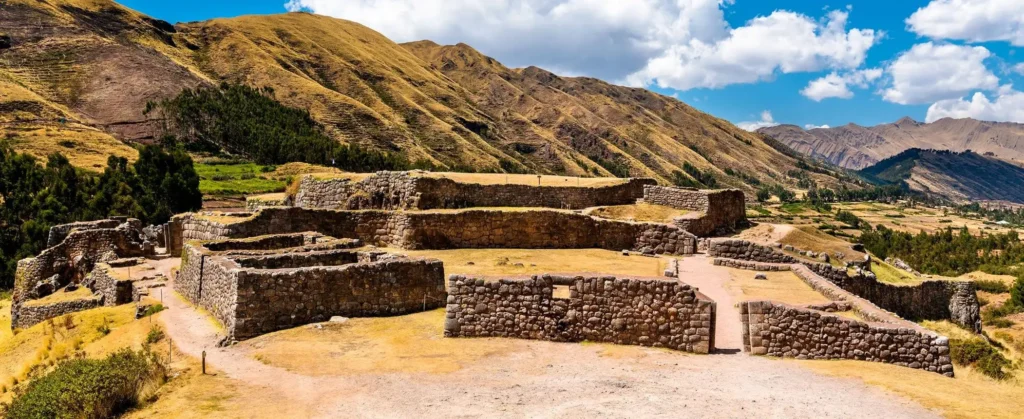
Archaeological Structures
Photograph the different levels of the site rather than focusing exclusively on individual walls. Wide-angle images can show how terraces, enclosures, and pathways were arranged across the hillside.
A good viewpoint can also reveal how the complex follows the natural contours of the terrain.
Stonework
Close-up photographs of Puka Pukara’s walls reveal the differences between individual stones. Some are relatively large and carefully fitted, while others form more practical masonry.
Look for:
- Irregular stone blocks.
- Carefully fitted joints.
- Wall corners.
- Doorways and entrances.
- Terraced retaining walls.
- Changes in masonry style.
These details can be easy to miss when simply walking through the site.
Landscape and Surrounding Mountains
The landscape is an essential part of the Puka Pukara experience. From the complex, visitors can see rolling Andean hills, agricultural areas, valleys, and distant mountains.
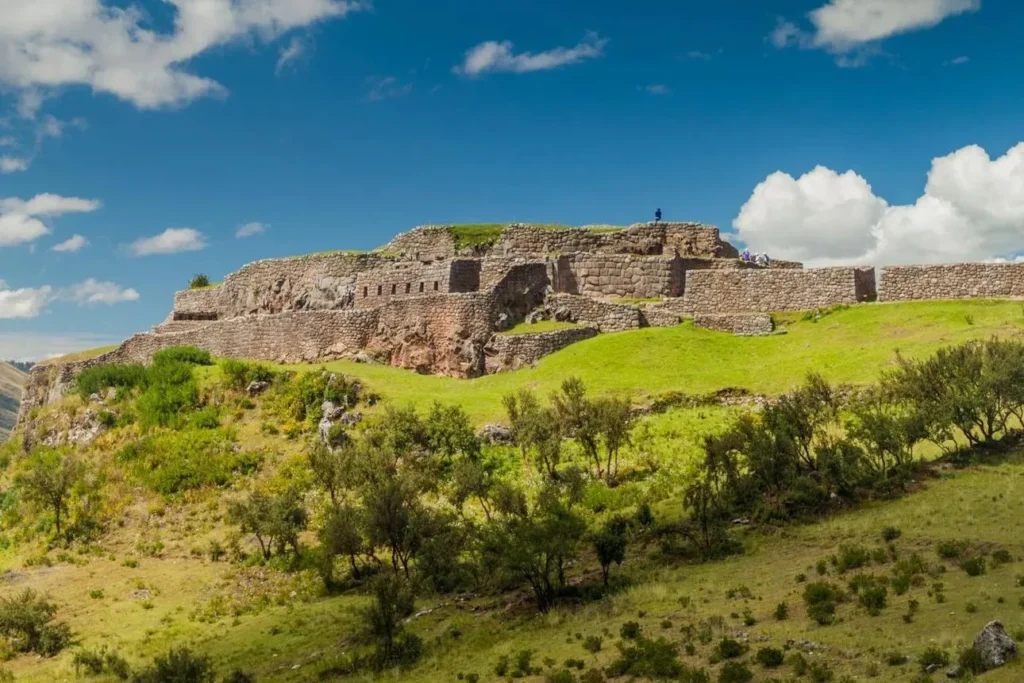
Photography is especially rewarding when clouds create dramatic shadows across the mountains or when late afternoon light gives the stone its characteristic reddish appearance.
Visiting Puka Pukara
Visiting Puka Pukara does not require a full day by itself. Most travelers include it as one stop within a broader Cusco archaeological excursion.
Its compact size makes it possible to explore the main areas relatively quickly, although travelers who enjoy photography and archaeology may want additional time.
How to Get There
There are several practical ways to reach Puka Pukara.
By Tourist Tour
A guided Cusco archaeological or city tour is one of the easiest options. These tours generally combine Puka Pukara with Sacsayhuaman, Qenqo, and Tambomachay.
The advantage is convenience: transportation and the overall route are organized in advance.
By Taxi or Private Transportation
A taxi or private vehicle offers greater flexibility. This option is useful for travelers who want to spend more time at specific sites or avoid moving according to a fixed group schedule.
It also makes it easier to combine Puka Pukara with additional attractions around Cusco.
By Walking
Experienced hikers can also explore routes connecting several archaeological sites. Walking allows visitors to appreciate the landscape more slowly and understand how the different sites relate to one another.
However, altitude should be taken seriously. A route that appears easy on a map can feel considerably more demanding at more than 3,500 meters above sea level.
What to See
During your visit, pay particular attention to the relationship between the architecture and the landscape.
The highlights include:
- Terraced stone platforms.
- Enclosure walls.
- Stone passageways.
- Elevated viewpoints.
- Small rooms and architectural remains.
- Inca masonry.
- Panoramic views of the Andes.
- The reddish appearance of the stones in certain light.
- The proximity of Tambomachay.
Rather than simply walking around the ruins, imagine how people would have moved through the complex when it was functioning as part of the Inca road and administrative system.
Recommended Visit Considerations
Puka Pukara is located at high altitude, so preparation can make the experience much more comfortable.
Consider bringing:
- Comfortable walking shoes.
- Water.
- Sunscreen.
- Sunglasses.
- A hat or cap.
- A light jacket or windbreaker.
- Layers of clothing.
- A camera or phone for photographs.
- Rain protection during the wet season.
Weather can change quickly in the highlands. A sunny morning can become cloudy or rainy, while strong sunlight can make the temperature feel warmer than expected.
Altitude and Acclimatization
Because Puka Pukara sits at roughly 3,700 meters above sea level, visitors who have recently arrived in Cusco should avoid treating the excursion like a low-altitude sightseeing walk.
Take your time, drink water, and avoid unnecessary exertion.
If you already feel tired from other activities, there is no need to rush. The archaeological complex is best appreciated slowly, with time to stop, observe the architecture, and enjoy the views.
Visitor Experience
One of the most appealing aspects of Puka Pukara is that it provides a different experience from Cusco’s largest monuments.
Sacsayhuaman can feel monumental and imposing. Qenqo is mysterious and strongly connected with carved rock and ritual spaces. Tambomachay is elegant and focused on water.
Puka Pukara feels more connected to movement and the landscape.
Standing among its walls, it is easy to understand why the Incas valued this location. Roads and valleys spread across the surrounding landscape, while the complex itself occupies an elevated position that provides natural visibility.
This combination of architecture, history, and scenery makes Puka Pukara an important part of the Cusco archaeological experience.
Why Should You Visit Puka Pukara?
Puka Pukara is sometimes overlooked because it is smaller than Sacsayhuaman and less famous than Machu Picchu. Yet this is exactly what makes it worthwhile.
The site offers a more intimate look at the practical side of the Inca Empire. Its terraces, rooms, walls, and pathways help visitors understand that the empire depended on much more than spectacular temples and royal estates.
Puka Pukara demonstrates how the Incas used strategic locations to organize travel, monitor routes, provide services, and connect different parts of their territory.
It is also one of the easiest archaeological sites to combine with other attractions in the Cusco area.
The Main Reasons to Include Puka Pukara in Your Cusco Itinerary
- It is close to Cusco.
- It can be combined with Qenqo and Sacsayhuaman.
- Tambomachay is nearby.
- The archaeological site provides panoramic Andean views.
- Its architecture illustrates the practical side of Inca planning.
- The reddish stone gives the site its distinctive appearance.
- It offers excellent photography opportunities.
- It helps explain the Inca road and administrative system.
- The visit can usually be completed without spending an entire day.
- It provides a quieter archaeological experience than some of Cusco’s most famous attractions.
Puka Pukara: A Small Site With a Strategic Role
Puka Pukara may not have the monumental scale of Sacsayhuaman, but its significance lies in what it reveals about the organization of the Inca world.
Its location, architecture, elevated position, and relationship with nearby archaeological sites all point toward a complex designed for practical purposes within a much larger system.
The meaning of its name, “Red Fortress,” captures the visual character of the ruins, but the site itself represents much more than a fortress. It was part of a landscape in which roads, water, ceremony, administration, lodging, and surveillance were interconnected.
For anyone exploring Puka Pukara Cusco, understanding this broader context makes the visit far more rewarding. Instead of seeing only a collection of ancient stone walls, travelers can recognize a carefully planned part of the infrastructure that supported one of the most remarkable civilizations in the Andes.
Today, Puka Pukara remains one of the essential stops on the Cusco archaeological circuit. Its combination of history, architecture, high-altitude scenery, and proximity to Qenqo and Tambomachay makes it an excellent addition to a Cusco itinerary—and a reminder that some of the most valuable archaeological discoveries are found not only in enormous monuments, but also in the smaller places that helped an empire function.
Leave a Reply