Cusco is one of the most remarkable historic cities in South America, famous for its Inca heritage, Spanish colonial architecture, archaeological sites, traditional neighborhoods, churches, museums, and dramatic Andean setting. The city was once the capital of the Inca Empire and remains one of the best places in Peru to understand the history and culture of the Andes.
The most important Cusco landmarks are concentrated around the historic center, but several extraordinary archaeological sites are located just outside the city. From the monumental walls of Sacsayhuamán and the ancient foundations of Qorikancha to Cusco Cathedral and the cobblestone streets of San Blas, the city offers a remarkable combination of pre-Columbian and colonial history.
Whether you have several days or only one day in Cusco, knowing which landmarks deserve priority can make your visit much easier. This guide covers the famous landmarks in Cusco, important attractions in the city center, archaeological sites, religious monuments, viewpoints, and the best way to organize the major sights.
Famous Landmarks in Cusco
The famous landmarks in Cusco reflect several different periods of the city’s history. Some date from the height of the Inca Empire, others were constructed during the Spanish colonial period, and many combine both traditions.
The most important landmarks include:
- Plaza de Armas
- Cusco Cathedral
- Qorikancha, or Temple of the Sun
- Sacsayhuamán
- Twelve-Angled Stone
- Hatun Rumiyoc Street
- San Blas Church
- San Cristóbal Church
- Q’enqo archaeological site
- Puka Pukara
- Tambomachay
- Cristo Blanco
- San Cristóbal viewpoint
- Inca walls
- Traditional colonial streets
- Historic churches
- Museums and cultural centers
What makes Cusco particularly special is the way these landmarks exist together. An Inca stone wall may form the foundation of a Spanish colonial building, while a centuries-old church stands only a short walk from an archaeological complex.
Landmarks in Cusco City Center
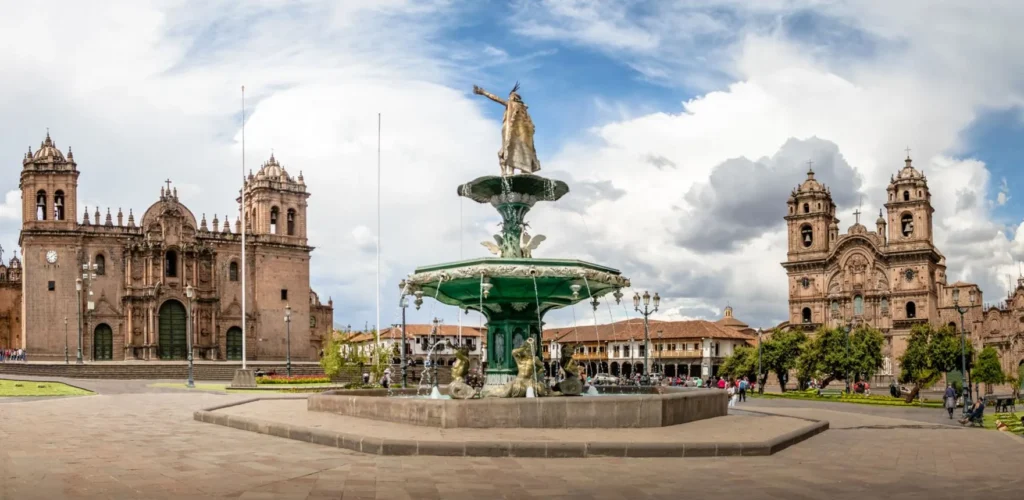
Many of the most important landmarks in Cusco city center are within walking distance of one another. The Plaza de Armas serves as the central reference point, with historic streets extending toward San Blas, Qorikancha, San Pedro, and other parts of the old city.
Plaza de Armas
The Plaza de Armas is the geographical and historical heart of Cusco. During the Inca period, the area was an important ceremonial and administrative space. Today, it is surrounded by colonial buildings, churches, restaurants, hotels, and shops.
The square is particularly impressive because it combines several layers of history in one location. Travelers can admire colonial arcades and churches while knowing that the area has been central to Cusco’s history for centuries.
The plaza is also an excellent starting point for a walking tour. From here, visitors can reach Cusco Cathedral, Hatun Rumiyoc, Qorikancha, San Blas, and numerous museums without needing transportation.
Cusco Cathedral
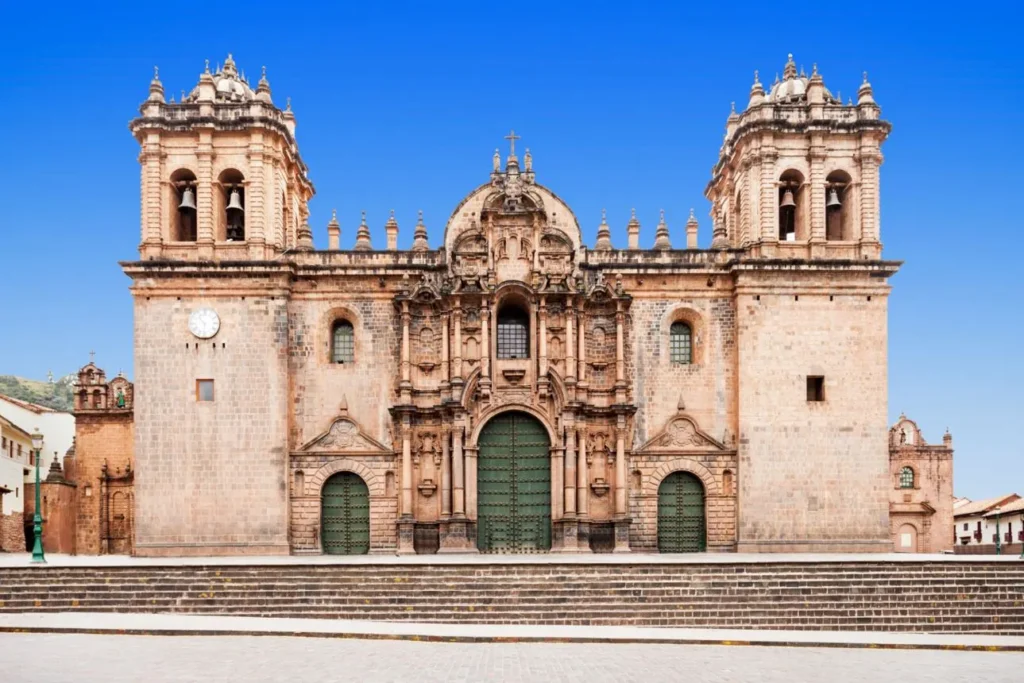
Cusco Cathedral is one of the city’s most recognizable landmarks and an essential stop for visitors interested in colonial architecture and religious art. It occupies a prominent position on the Plaza de Armas and forms part of the historic architectural ensemble surrounding the square.
Inside, visitors can see colonial paintings, religious sculptures, elaborate altars, and artwork associated with the Cusco School of Art. The building also demonstrates how European artistic traditions developed a distinctive Andean character after arriving in Peru.
Cusco Cathedral is especially important because it represents the colonial layer of Cusco’s history. When combined with nearby Inca landmarks, it helps visitors understand the dramatic cultural transformation of the city.
Qorikancha
Qorikancha, traditionally known as the Temple of the Sun, was one of the most important religious complexes of the Inca Empire. The temple was dedicated to the Sun and held enormous religious and political importance.
Although the original complex was transformed during the colonial period, important sections of Inca stonework remain. The contrast between the precisely fitted Inca walls and the colonial Church of Santo Domingo makes Qorikancha one of the most fascinating landmarks in Cusco.
Visitors interested in architecture should pay particular attention to the precision of the stonework. The smooth surfaces, carefully shaped blocks, and remarkable construction techniques illustrate the sophistication of Inca engineering.
Twelve-Angled Stone
The Twelve-Angled Stone is one of the most recognizable examples of Inca masonry in the historic center. Located along Hatun Rumiyoc Street, the stone forms part of a larger wall made from enormous blocks fitted together with extraordinary precision.
The landmark is relatively small compared with Sacsayhuamán or Qorikancha, but it is valuable because it can be seen while walking through the historic center. It demonstrates how Inca architecture remains integrated into modern Cusco.
Hatun Rumiyoc Street
Hatun Rumiyoc is more than simply a route between attractions. It is itself a historical landmark. The narrow street contains remarkable Inca masonry and provides one of the clearest examples of the relationship between the ancient city and colonial Cusco.
Walking along Hatun Rumiyoc toward San Blas is one of the best ways to appreciate the city’s architecture at street level.
Other Famous Cusco Landmarks
Beyond the principal attractions in the historic center, several other landmarks are important for understanding Cusco’s history and geography.
Sacsayhuamán
Sacsayhuamán is arguably the most impressive archaeological landmark near Cusco. Located on a hill overlooking the city, the complex is famous for enormous stone blocks fitted together with exceptional precision.
The scale of the stones is difficult to appreciate from photographs alone. Some blocks are enormous, and the construction demonstrates the extraordinary logistical and engineering capabilities of the Inca civilization.
The elevated location also provides excellent views over Cusco and the surrounding mountains. Because of its proximity to the city, Sacsayhuamán is often combined with other nearby archaeological sites.
Q’enqo
Q’enqo is another important archaeological landmark near Cusco. The site contains carved rock formations, ceremonial spaces, channels, and subterranean areas.
Compared with Sacsayhuamán, Q’enqo is smaller and more intimate. Its significance comes from the ceremonial elements carved directly into the stone and its connection to the religious practices of the Inca period.
Puka Pukara
Puka Pukara is located along the road between Cusco and Tambomachay. The site consists of stone terraces, walls, and structures positioned on elevated terrain.
Its name is commonly translated as “Red Fortress,” although its exact historical function has been debated. The location offers broad views across the surrounding landscape, making it an interesting stop for visitors exploring the archaeological sites outside Cusco.
Tambomachay
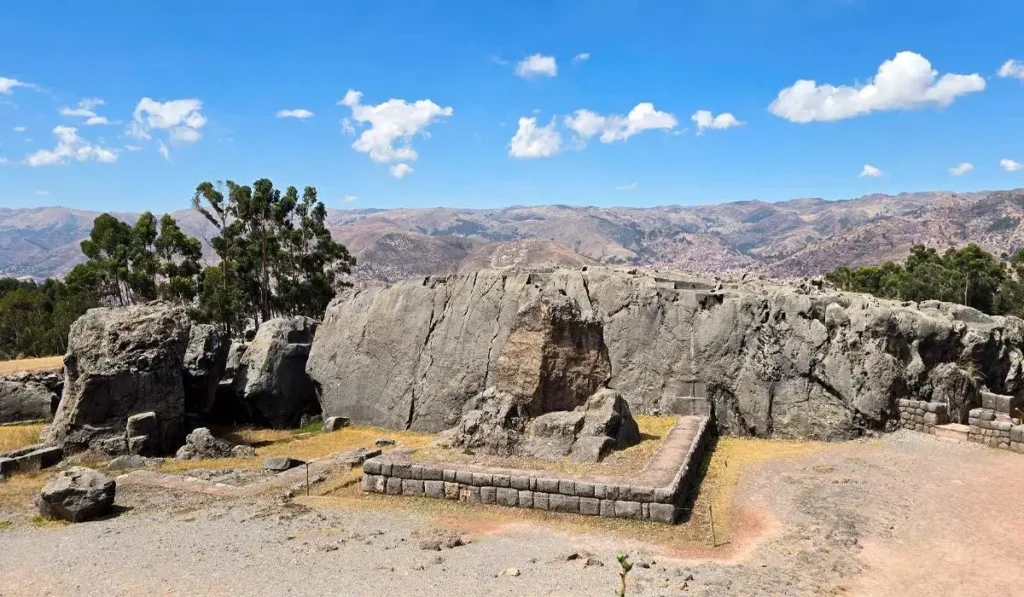
Tambomachay is associated with water and ceremonial architecture. Its channels, fountains, and carefully constructed stone features demonstrate the importance of water in Inca culture.
The peaceful atmosphere distinguishes Tambomachay from the larger and more dramatic Sacsayhuamán. It is typically visited as part of a route that includes several archaeological landmarks north of Cusco.
Famous Landmarks in Cusco Peru: Churches and Colonial Architecture
The famous landmarks in Cusco Peru are not limited to Inca archaeological sites. The city also contains an extraordinary collection of churches, colonial buildings, plazas, and streets.
Church of La Compañía de Jesús
The Church of La Compañía de Jesús stands prominently on the Plaza de Armas and is one of the finest examples of Baroque architecture in Cusco. Its elaborate facade contrasts with the simpler geometry of many surrounding buildings.
The church is particularly striking when viewed from the center of the plaza. Its interior also contains ornate decoration and religious artwork.
San Blas Church
San Blas Church is located in one of Cusco’s most attractive traditional neighborhoods. The church is associated with artisans and the artistic heritage of the area.
The San Blas neighborhood itself is an attraction worth exploring. Its narrow streets, stone walls, whitewashed buildings, artisan workshops, cafés, and steep paths provide a different atmosphere from the busier Plaza de Armas.
San Cristóbal Church
The Church of San Cristóbal sits on a hill overlooking Cusco. The location is valuable not only for its architecture but also for the panoramic views of the city.
Visitors can combine the church with the nearby San Cristóbal viewpoint for one of the most rewarding photographic perspectives of Cusco.
Cusco Landmarks and Attractions Map
A mental Cusco landmarks and attractions map is useful because the city can be divided into several practical sightseeing zones.
Historic Center Zone
The central zone includes the highest concentration of landmarks:
- Plaza de Armas
- Cusco Cathedral
- Church of La Compañía
- Qorikancha
- Hatun Rumiyoc
- Twelve-Angled Stone
- Museums
- Colonial streets
These attractions are generally suitable for a walking itinerary.
San Blas Zone
The San Blas area includes:
- San Blas Church
- San Blas Plaza
- Artisan workshops
- Traditional streets
- San Blas viewpoint
- Cafés and restaurants
The neighborhood is located uphill from the main square, so visitors should be prepared for steep streets.
Northern Archaeological Zone
The archaeological area above Cusco includes:
- Sacsayhuamán
- Q’enqo
- Puka Pukara
- Tambomachay
- Cristo Blanco
These sites are better visited using a combination of walking and transportation because of the distances and elevation changes.
Southern and Central Cultural Zone
The area around Qorikancha and the central historic district provides access to:
- Qorikancha
- Santo Domingo
- Avenida El Sol
- Museums
- Colonial buildings
- Traditional restaurants
Understanding these zones makes it easier to organize a sightseeing day without constantly crossing the city.
What Is Cusco Known For?
So, what is Cusco known for? Above all, Cusco is known as the historic capital of the Inca Empire and as the principal gateway to Machu Picchu.
However, the city has a much broader identity.
Cusco is known for:
- Inca civilization
- Inca stone architecture
- Machu Picchu access
- Sacsayhuamán
- Qorikancha
- Cusco Cathedral
- Colonial architecture
- Andean traditions
- Traditional textiles
- Indigenous culture
- Peruvian cuisine
- Historic churches
- San Blas artisans
- Archaeological sites
- Sacred Valley excursions
- High-altitude Andean landscapes
The city’s importance is not simply historical. Cusco remains a living cultural center where Andean traditions coexist with modern Peruvian life.
Cusco as the Inca Capital
Cusco was the political and cultural center of the Inca Empire. The city’s original layout and architecture reflected the importance of the imperial capital.
Many modern buildings incorporate or stand above Inca foundations, making the ancient city visible beneath the colonial one.
Cusco as a Cultural Destination
Cusco is also known for its festivals, traditional clothing, music, dance, handicrafts, food, and religious traditions. The cultural experience extends beyond museums and monuments.
For travelers, this means that visiting Cusco is not only about seeing historical landmarks. It is also an opportunity to observe how Andean traditions continue to influence everyday life.
Cusco Landmarks to See in One Day
Travelers with limited time can still see many important Cusco landmarks in one day if they concentrate on the historic center and organize the route efficiently.
Morning: Plaza de Armas and Historic Center
Begin at the Plaza de Armas. Visit Cusco Cathedral and explore the surrounding colonial buildings before walking toward Hatun Rumiyoc and the Twelve-Angled Stone.
Continue toward San Blas and spend some time exploring its streets.
Afternoon: Qorikancha and Sacsayhuamán
After lunch, visit Qorikancha and then travel toward Sacsayhuamán. If time permits, include Q’enko or Cristo Blanco.
This combination provides a good balance of colonial, Inca, archaeological, and panoramic attractions.
Evening: Return to the Historic Center
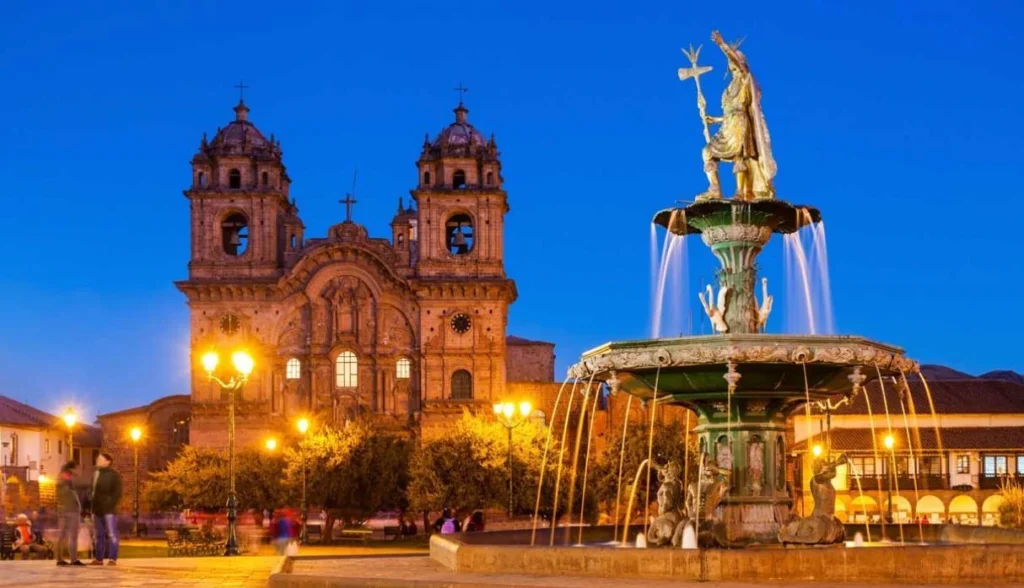
Return to the Plaza de Armas for dinner. The historic center takes on a different character after sunset, when the illuminated churches and colonial buildings create a dramatic atmosphere.
Cusco Landmarks Photos: Best Places for Photography
Cusco landmarks photos are an important part of the travel experience because the city offers an unusual combination of architecture, mountains, stonework, and colorful cultural scenes.
Some landmarks are particularly photogenic.
Best Photography Locations
- Plaza de Armas
- Cusco Cathedral
- Church of La Compañía
- Hatun Rumiyoc
- Twelve-Angled Stone
- San Blas
- San Cristóbal viewpoint
- Cristo Blanco
- Sacsayhuamán
- Qorikancha
- Traditional colonial streets
- Local markets
Best Time for Cusco Landmark Photos
Early morning is ideal for quieter streets and softer light. The historic center can become busy during the middle of the day, so travelers interested in architectural photography should consider starting early.
Late afternoon is excellent for panoramic views, particularly from elevated locations such as San Cristóbal and Cristo Blanco.
Night photography around the Plaza de Armas can also be impressive because the illuminated colonial architecture creates strong contrasts between the buildings and the surrounding darkness.
How to Explore Cusco’s Landmarks
The best sightseeing strategy depends on the amount of time available and your interests.
For First-Time Visitors
First-time visitors should prioritize:
- Plaza de Armas
- Cusco Cathedral
- Qorikancha
- Hatun Rumiyoc
- San Blas
- Sacsayhuamán
- Cristo Blanco
These attractions provide an excellent introduction to the city’s history, architecture, and geography.
For History Enthusiasts
Travelers particularly interested in history should spend additional time at:
- Sacsayhuamán
- Qorikancha
- Q’enqo
- Puka Pukara
- Tambomachay
- Cusco Cathedral
- Historic churches
- Archaeological and cultural museums
- Inca stone walls
For Photography Enthusiasts
Photography-focused travelers should prioritize:
- Plaza de Armas
- San Cristóbal viewpoint
- Cristo Blanco
- Sacsayhuamán
- San Blas
- Hatun Rumiyoc
- Colonial streets
- Local markets
Each offers a different visual perspective of Cusco.
Practical Tips for Visiting Cusco Landmarks
Allow Time to Acclimatize
Cusco sits at a high elevation, and some visitors notice the altitude soon after arriving. The first day should be relatively relaxed, especially if you are coming directly from a much lower elevation.
Wear Comfortable Shoes
The historic center contains cobblestones, uneven surfaces, steep streets, and steps. Comfortable walking shoes are essential.
Combine Nearby Attractions
Avoid creating an itinerary that repeatedly crosses the city. Group attractions geographically to save time and energy.
Visit Both Inca and Colonial Sites
One of the biggest mistakes is focusing exclusively on either Inca archaeology or colonial architecture. Cusco’s uniqueness comes from the combination of both.
Look Beyond the Main Square
The Plaza de Armas is spectacular, but some of the city’s most memorable experiences can be found in San Blas, local markets, small streets, viewpoints, and archaeological sites outside the center.
Why Cusco Landmarks Are Worth Visiting
The Cusco landmarks tell the story of one of the most important cities in the Andes. Inca engineering, colonial architecture, religious art, traditional culture, and modern Peruvian life all exist within a relatively compact destination.
The most famous landmarks—Sacsayhuamán, Qorikancha, Cusco Cathedral, Plaza de Armas, and the Twelve-Angled Stone—provide a strong introduction to the city’s history. Meanwhile, San Blas, local markets, viewpoints, churches, and quieter streets reveal another side of Cusco.
If you have only one day, focus on the historic center and Sacsayhuamán. With two or three days, add more archaeological sites, museums, neighborhoods, and cultural experiences. And if you have additional time, use Cusco as a base for exploring the Sacred Valley and other destinations in the Andes.
Ultimately, Cusco is much more than a gateway to Machu Picchu. Its landmarks preserve centuries of history while its living culture continues to shape the identity of the Andes. For anyone traveling through Peru, taking time to explore these landmarks is one of the best ways to understand the country’s extraordinary past and present.
Leave a Reply