The Inca walls in Cusco are among the most remarkable features of Peru’s former imperial capital. Along historic streets, enormous stones fit together with carefully shaped joints, supporting buildings that reflect several centuries of change. These walls are not simply archaeological attractions: many remain part of the city’s everyday streetscape, connecting modern Cusco with its Inca foundations.
Exploring Inca walls in Cusco, Peru, reveals how architecture expressed political authority, adapted to mountainous conditions, and organized urban space. From the famous Twelve-Angled Stone to quieter stretches of masonry, this guide explains their history, construction, significant locations, walking routes, and photographic details.
What Are the Inca Walls in Cusco?
Understanding the Stone Walls Built by the Inca
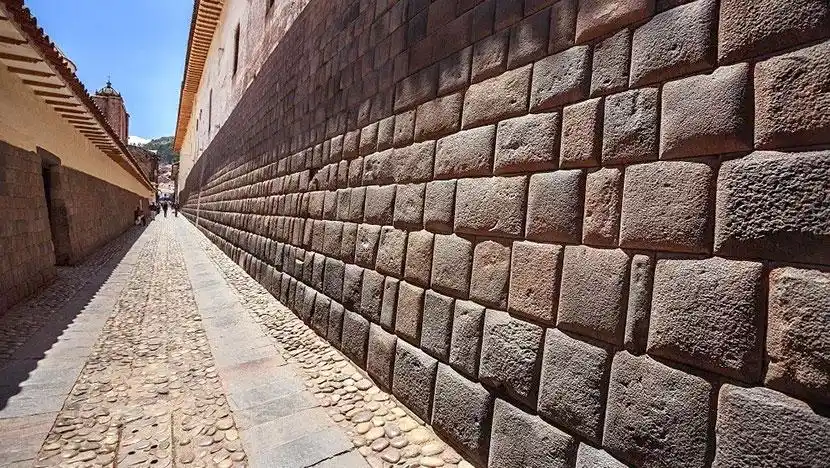
The Inca walls in Cusco are surviving architectural elements of palaces, religious compounds, terraces, and other structures built or substantially developed during the Inca period. Many are recognizable by fitted stonework, although Inca builders used several masonry styles. Some walls contain regular rectangular blocks, while others feature irregular stones shaped to meet their neighbors. Fine examples were assembled without mortar in their visible joints, but not every Inca structure used the same materials or construction method.
What visitors see today is usually part of a larger, altered building rather than a complete original structure. Roofs, upper walls, entrances, and internal arrangements often changed after the Spanish conquest. Nevertheless, surviving foundations and lower wall courses preserve evidence of Inca planning. Their relationship to streets, courtyards, and neighboring compounds helps explain how the imperial capital once functioned.
Why Inca Walls Cusco Peru Searches Lead to a Living City
Unlike archaeological sites separated from modern settlements, many Inca ruins in Cusco City remain embedded in occupied neighborhoods. A stone foundation may support a later residence, border a busy pedestrian lane, or appear inside a museum courtyard. This continuity makes Cusco distinctive: travelers encounter ancient architecture while moving between ordinary urban spaces. Understanding these walls therefore requires looking beyond individual stones to the layered buildings around them.
History of the Inca Walls in Cusco
Development of Inca Architecture
Inca architecture developed within a much longer Andean tradition of stone construction, agricultural terracing, and ceremonial building. Earlier societies had already established sophisticated approaches to working in mountainous landscapes. Inca builders adapted this inherited knowledge and expanded it through imperial organization. Cusco became a particularly important setting for monumental architecture, where skilled labor and materials could be concentrated in buildings associated with government, religion, and elite households.
Imperial Expansion and Urban Transformation
During the fifteenth century, the growth of the Inca state brought major changes to Cusco. Rulers sponsored the rebuilding and enlargement of important compounds, while streets, waterways, and ceremonial spaces helped organize the capital. Fine masonry became a visible expression of institutional power. Dating individual surviving walls precisely can be difficult, however, because buildings were modified repeatedly and historical accounts do not provide a complete construction sequence.
Historical Importance of Cusco’s Stone Walls
Cusco’s stone walls communicated distinctions between ordinary buildings and spaces associated with higher status or sacred activity. Carefully finished masonry required substantial skill, time, and coordination, making it especially appropriate for significant compounds. Walls also defined access: entrances, narrow passages, and enclosed courtyards shaped how people moved through the city. Their historical importance lies in this combination of practical construction, urban organization, and political symbolism.
Conquest, Rebuilding, and Architectural Survival
Following the Spanish conquest in the sixteenth century, many Inca buildings were dismantled, adapted, or incorporated into new structures. Existing stone foundations offered useful bases for colonial construction, producing the architectural layering visible throughout the historic center. Earthquakes and later repairs added further changes. A wall encountered today may therefore include original Inca masonry, reused blocks, reconstructed sections, and later additions rather than one untouched phase.
Inca Stonework and Architecture
Precision of Inca Masonry
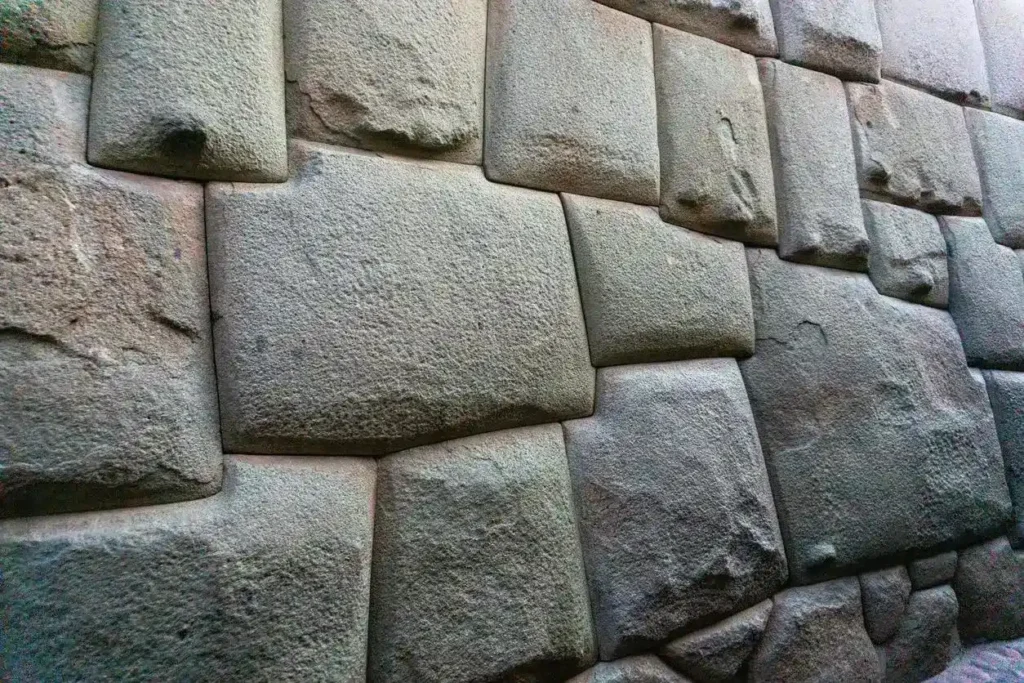
The precision of Inca masonry is most apparent where neighboring stones meet along narrow, carefully worked joints. Instead of relying on thick mortar beds to hide differences, masons shaped contact surfaces to achieve close fits. In polygonal walls, a single block may meet several surrounding stones at different angles. This required attention to the relationship between each block and the developing wall, not merely skill in producing an attractive exposed face.
Polygonal Masonry and Rectangular Stonework
Polygonal masonry uses irregular, multi-sided blocks arranged into interlocking patterns. Rectangular or coursed masonry creates a more regular appearance, often with stones organized into horizontal rows. Both occur in Inca architecture, and neither should be treated as the only authentic style. Differences can reflect building function, available stone, desired finish, and construction context. Comparing these styles is one of the most rewarding activities when exploring Cusco’s historic architecture.
Stone Carving and Surface Finishing
Archaeological evidence supports the use of stone tools for much of the demanding work of shaping building blocks. Hard hammerstones could remove material through repeated percussion, while additional dressing refined surfaces and edges. The result depended on the rock being worked and the intended finish. Some exposed faces remain rounded or visibly textured; others are much flatter. These variations show that Inca stone carving followed several practical and aesthetic approaches.
What Tool Marks Can Reveal
Small depressions, pecked textures, and changes in surface treatment can help visitors imagine the repeated actions involved in shaping a block. However, weathering and later repairs may obscure or alter these traces. An unusually smooth surface is not evidence by itself of an unknown technology. Careful observation is more useful than assuming that every surviving feature has a single explanation, particularly in a city where stone has been reused extensively.
Construction Techniques: Quarrying, Transport, and Assembly
Building a major stone compound involved selecting suitable rock, extracting blocks, transporting them, preparing foundations, and fitting the masonry. Inca organization made large labor forces available for state projects, but individual tasks still required specialized knowledge. Ropes, prepared routes, ramps, and coordinated human effort are consistent with archaeological and historical understanding of Andean construction. Exact procedures varied by location, and the complete sequence cannot be reconstructed for every wall.
How Stones Were Fitted Together
The close joins suggest repeated checking and adjustment during assembly. Builders could remove high points and refine adjoining surfaces until blocks seated satisfactorily. Nevertheless, no surviving technical manual explains every fitting method, and researchers continue to investigate the details. It is reasonable to describe the work as a controlled, labor-intensive process without presenting one modern reconstruction as a universally proven account of how all Inca walls were built.
Earthquake Resistance and Structural Design
Cusco lies in an earthquake-prone region, making structural performance an important part of discussions about Inca engineering. Features such as substantial wall thickness, inward inclination in some structures, strong foundations, and carefully arranged masonry could contribute to stability. Trapezoidal openings are another recognizable architectural feature. These elements should be understood together rather than reducing earthquake resistance to the popular claim that tightly fitted stones simply “move and return” without damage.
Inca buildings were not earthquake-proof. Their survival depends on factors including location, construction quality, maintenance, and subsequent alterations. Some walls have required repair or reconstruction, and later buildings resting on ancient foundations create different structural conditions. The impressive endurance of surviving masonry remains significant, but it does not justify absolute claims about indestructibility.
Inca Stonework Theories: Evidence and Speculation
Inca stonework theories range from serious experiments with tools and transport to unsupported stories about softened rock or lost supernatural knowledge. The strongest explanations begin with archaeological evidence, surviving tool marks, quarry remains, and practical testing. Important uncertainties remain, especially about particular sequences of movement and fitting. Those uncertainties do not diminish the achievement: they highlight the expertise of Andean builders and the limits of the surviving record.
Famous Inca Walls and Buildings in Cusco
The Twelve-Angled Stone in Cusco
The Twelve-Angled Stone is the best-known individual block in Cusco’s historic center. Located on Hatun Rumiyoc Street, it forms part of a substantial wall associated with an Inca elite compound and incorporated into a later building. Its fame comes from the complex outline of its visible face and the close joints connecting it to adjacent blocks. Travelers searching for “12 Angled Stone Cusco” are looking for this same landmark.
Its Stonework and Twelve-Angled Outline
The stone’s outline changes direction repeatedly as it meets neighboring blocks, producing the twelve angles that give it its name. The important feature is not simply the number of corners but the coordination of the surrounding masonry. Each adjoining stone contributes to the fit. Looking at the whole wall reveals how different sizes and shapes were combined into a coherent structure rather than assembled as isolated display pieces.
Why It Is a Notable Example of Inca Masonry
The Twelve-Angled Stone provides an accessible example of precision fitting at street level. Visitors can appreciate its scale and joints without entering a remote archaeological site. However, it is neither the only complex stone in Cusco nor a complete summary of Inca architecture. Its greatest educational value comes from comparing it with nearby blocks, different masonry styles, and the broader architectural setting.
Qorikancha and Its Surviving Inca Walls
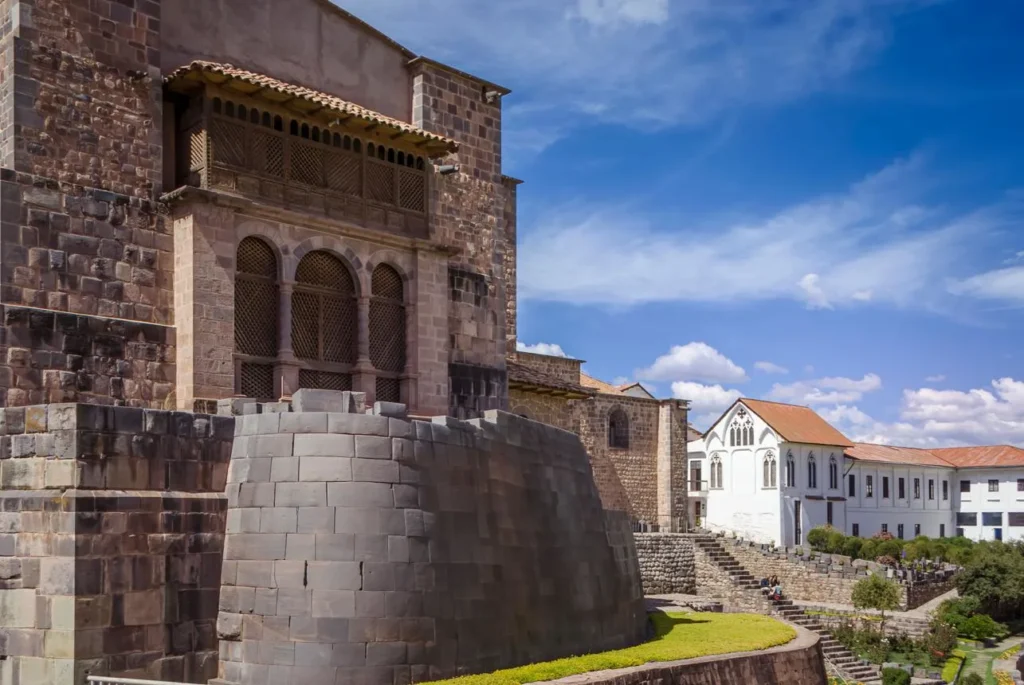
Qorikancha was one of the most important religious complexes in the Inca capital. Its surviving masonry includes exceptionally refined stonework, with orderly courses and carefully finished surfaces. Compared with the irregular outlines on Hatun Rumiyoc, these walls demonstrate another expression of Inca precision. The site is particularly valuable for understanding how architectural finish could reinforce the importance of a sacred space.
Religious Architecture and Later Construction
Later religious buildings occupy and incorporate parts of the former Inca complex, creating a striking example of architectural transformation. Visitors should distinguish the surviving Inca elements from colonial structures and modern conservation work. Examining wall alignments, openings, and changes in material helps reveal these layers. Access to interior sections depends on current opening arrangements, so it is sensible to confirm conditions locally before planning a visit.
Saqsaywaman Above Cusco
Saqsaywaman, also commonly spelled Sacsayhuamán, stands on the heights above the historic center. Its immense stone walls broaden the experience beyond the narrower streets below. The site formed part of a major complex with ceremonial and defensive significance, although its functions should not be reduced to a simple fortress label. The surviving masonry demonstrates the scale at which Inca builders could organize quarrying, transport, and construction.
How Its Masonry Differs from Central Cusco
The most obvious difference is the enormous size of many blocks and the sweeping arrangement of the monumental walls. In central Cusco, visitors often study close joints from a narrow pavement; here, they can also observe large-scale planning across an open landscape. Combining both settings provides a more complete picture of Inca stonework, from refined urban architecture to monumental construction integrated with the terrain.
Where to See Inca Walls in Cusco
Historic Streets: Hatun Rumiyoc and Beyond
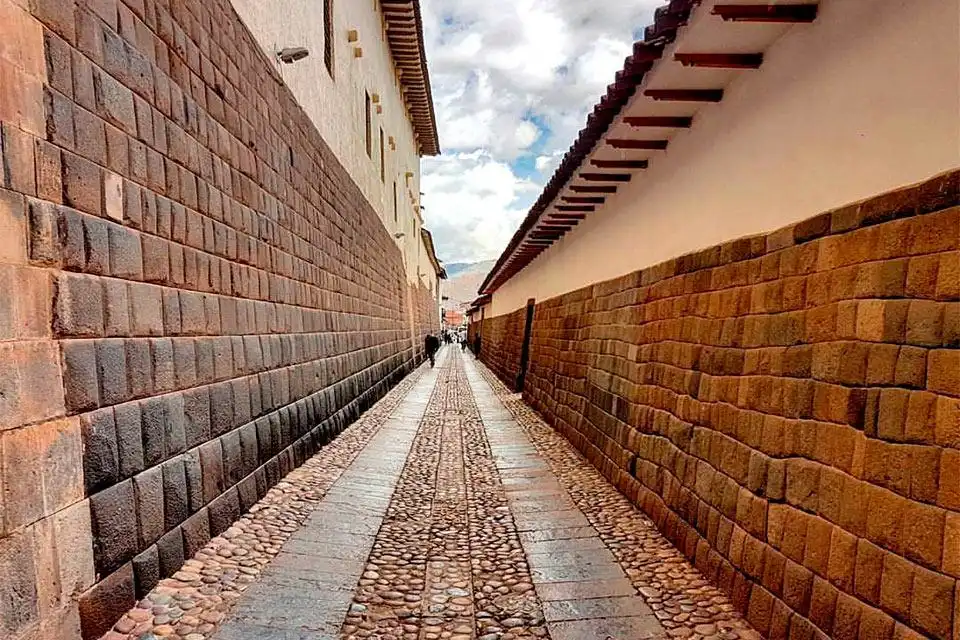
Hatun Rumiyoc is the essential starting point for visitors interested in famous Inca walls. Nearby streets, including Inca Roca and areas around the historic center’s old compounds, offer further opportunities to observe masonry within later buildings. Walk slowly and examine corners, doorway surrounds, and lower wall courses. Not every stone façade is Inca, so appearance alone should not be used to assign a date or original function.
Loreto Street and the Area Around the Main Square
Loreto Street is another important location for viewing long stretches of historic stonework close to Cusco’s main square. Its narrow proportions help visitors appreciate how walls shaped movement through the urban center. Rather than focusing exclusively on famous blocks, study the overall height, stone courses, and relationships between opposing façades. These features communicate the experience of enclosed streets and substantial compounds more clearly than a close-up photograph alone.
Finding Inca Ruins in Cusco City
Inca remains appear in courtyards, cultural buildings, and properties whose street fronts do not reveal everything behind them. Some spaces are publicly accessible; others require admission or remain private. A productive approach is to combine freely visible street walls with one or two established archaeological visits. This avoids treating the historic center as a checklist and allows enough time to distinguish original remains from subsequent rebuilding.
Using a Cusco Map to Plan Your Route
On a Cusco map, locate the main square, Hatun Rumiyoc, Loreto Street, and Qorikancha before deciding your walking order. These central stops can be combined without repeatedly crossing the same streets. Saqsaywaman belongs in a separate uphill extension or another outing, especially while acclimatizing. Map distances can be misleading because slopes, steps, crowds, and altitude affect walking time more than the short distances suggest.
- Central starting point: Orient yourself around the main square.
- Eastern stop: Explore Hatun Rumiyoc and the Twelve-Angled Stone.
- Southern continuation: Include Loreto Street and Qorikancha.
- Higher-elevation extension: Visit Saqsaywaman when comfortable with the altitude.
Inca Walls Cusco Tours and Guided Visits
What Guided Visits Can Explain
Inca walls Cusco tours are most useful when they connect visible features with historical context. A knowledgeable guide can explain masonry types, identify likely alterations, and clarify why different buildings received different finishes. Good interpretation also separates well-supported information from legend. Before joining a visit, ask whether it emphasizes architecture and archaeology or mainly offers a general introduction to the city’s major attractions.
Walking Tours and Independent Exploration
Walking tours suit central Cusco because several important walls lie within a compact area. An organized walk can provide structure, while independent exploration allows more time for photography and comparison. Either approach benefits from a limited itinerary rather than too many stops. Admission-based interiors, steep extensions, and transport to higher sites should be considered separately when estimating the total time and physical effort required.
What Visitors Can See Along the Way
Beyond famous stones, visitors can look for changes in block size, masonry courses, corner construction, recessed openings, and junctions between older and newer materials. Some features are easiest to understand from across the street rather than immediately beside the wall. A rewarding visit alternates close observation with wider views, connecting the craftsmanship of individual blocks to the scale and organization of entire buildings.
Inca Walls Cusco Photos: What to Capture
Stonework Details and Close-Up Photography
For memorable Inca walls Cusco photos, concentrate on the junctions where several stones meet. These details reveal the careful geometry more clearly than a single isolated surface. Side lighting can emphasize shallow textures and joint lines, while diffuse light can reduce harsh contrast. Photograph without touching the masonry, inserting objects into joints, or asking someone to climb onto architectural features for scale.
Walls and Streets in Their Urban Setting
Wider photographs show how ancient walls remain part of contemporary Cusco. Include a receding street, a building corner, or the transition from stone foundations to later upper floors. These compositions communicate historical layering rather than presenting the masonry as a disconnected artifact. Early visits may offer less crowded scenes, but conditions vary, and narrow streets should always remain accessible to residents and other pedestrians.
Photographing the Twelve-Angled Stone Respectfully
The Twelve-Angled Stone attracts frequent groups, making patience more useful than rushing forward. Take an overall image that includes neighboring blocks before capturing the famous outline more closely. Avoid leaning against the wall or obstructing the street for extended periods. A photograph of the surrounding masonry is also valuable because it records the structural relationships that explain why the stone is significant.
Architectural Features Worth Documenting
Create a varied photographic record by including corners, wall inclinations where visible, openings, stone courses, and changes in surface finish. Comparing these images afterward can reveal distinctions that were easy to miss during the walk. Record the location of each photograph in your notes, since similar-looking details can become difficult to identify later. Do not assume that every trapezoidal opening or fitted stone belongs to an original Inca construction phase.
Practical Tips for Visiting Cusco’s Inca Walls
Altitude, Weather, and Walking Comfort
Cusco sits at approximately 3,400 meters above sea level, so even a short architectural walk can feel demanding soon after arrival. Begin gently, take breaks, and avoid combining your first stroll with a strenuous uphill extension. Comfortable footwear is important on uneven paving, especially when wet. Sun protection and a light waterproof layer are useful because exposure and weather conditions can change during a single outing.
Protecting the Stonework
These walls are cultural heritage, not climbing surfaces or props. Avoid touching fragile areas, rubbing joints, leaving marks, or placing equipment directly against the stone. Follow barriers and local instructions, including photography restrictions inside buildings. Responsible visiting also means respecting private entrances and allowing daily life to continue around popular landmarks. Small acts of care help preserve both the masonry and the character of the surrounding streets.
Why Cusco’s Inca Walls Deserve a Closer Look
The Inca walls in Cusco reward attention at every scale: individual joints reveal skilled craftsmanship, complete façades express architectural choices, and connected streets preserve traces of an imperial capital. Visiting the Twelve-Angled Stone, Qorikancha, and Saqsaywaman provides contrasting perspectives on the same building tradition. The most meaningful experience comes from looking carefully, recognizing historical layers, and appreciating the human knowledge behind these enduring stone structures.
Leave a Reply