The Plaza de Armas Cusco is the historic and cultural heart of Cusco, Peru. Surrounded by colonial churches, traditional arcades, restaurants, hotels, and centuries-old streets, the square is one of the first places most travelers visit when exploring the former capital of the Inca Empire.
Known as Plaza de Armas Cusco Peru, this central square has a history that goes far beyond the Spanish colonial period. Long before the arrival of the Spanish, the area was an important ceremonial and political space in the Inca capital. Today, visitors can still see traces of that ancient city in the stone foundations and streets surrounding the plaza.
The square is also one of the best starting points for exploring the Cusco Historic Center. From here, travelers can easily walk to the cathedral, Qorikancha, Hatun Rumiyoc, San Blas, museums, markets, and numerous historic churches and monuments.
About Plaza de Armas Cusco
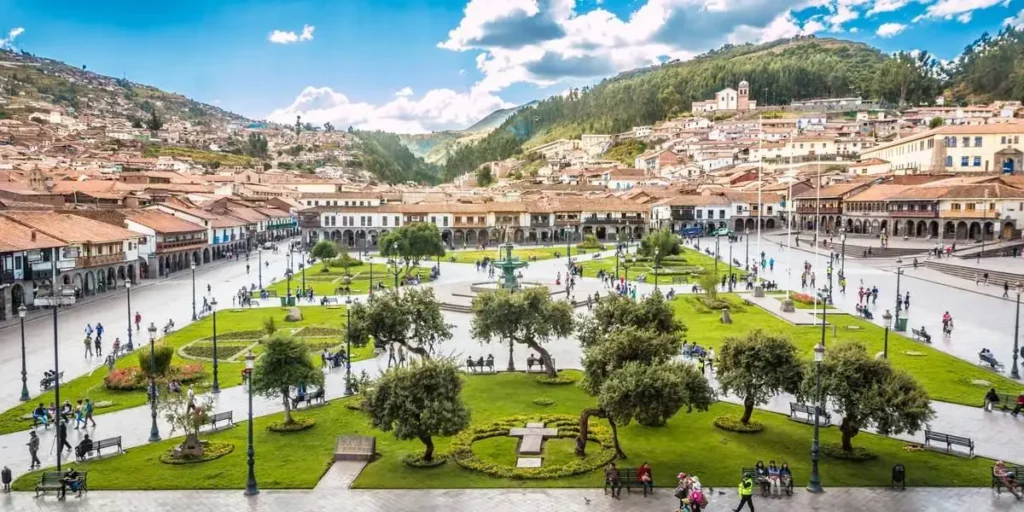
The Plaza de Armas is the principal public square in central Cusco and one of the most recognizable landmarks in Peru. Its Spanish colonial appearance—with green gardens, a central fountain, stone arcades, and imposing churches—can make it seem like a purely colonial space, but its origins are much older.
The square occupies a strategic location within the historic center and is surrounded by some of the most important buildings in Cusco. Visitors can spend time here simply enjoying the atmosphere or use it as the starting point for a longer walking tour.
Plaza de Armas Cusco Peru
The plaza is located in the city of Cusco, in the Andes of southeastern Peru. Because Cusco was once the capital of the Inca Empire and later became an important Spanish colonial center, the square represents several periods of Peruvian history in one location.
It is surrounded by restaurants, cafés, shops, travel agencies, hotels, churches, and historic buildings, making it one of the busiest areas of the city.
The square is also a popular meeting point for local residents and travelers. During the day, it can be lively and crowded, while early mornings and evenings offer a quieter atmosphere.
importancia de la plaza
The importance of the Plaza de Armas comes from its combination of history, architecture, culture, and everyday life.
Its importance can be understood through several aspects:
- It occupies the center of historic Cusco.
- It was an important area during the Inca period.
- It became a major colonial public space after the Spanish conquest.
- It is surrounded by important churches and historic buildings.
- It is one of the city’s main meeting points.
- It provides access to many major attractions.
- It remains an active public space rather than simply an archaeological monument.
- It is an important location for celebrations and cultural events.
For visitors, this makes the plaza much more than a place to take photographs. It is an excellent introduction to the history and character of Cusco.
ubicación dentro del Centro Histórico
The Plaza de Armas occupies a central position within Cusco’s Historic Center. Because so many major attractions are located nearby, travelers staying in the center can reach much of the historic district on foot.
The cathedral and Compañía de Jesús are directly around the square, while streets leading from the plaza connect travelers with Qorikancha, San Blas, San Pedro Market, Hatun Rumiyoc, museums, and other monuments.
This central position is one of the reasons the plaza is such a useful reference point when navigating Cusco.
History of Plaza de Armas Cusco
The History of Plaza de Armas Cusco begins during the Inca period, when Cusco was the political and religious center of an expanding empire. The square has changed considerably over time, but its central importance has remained.
Understanding the history of the plaza helps explain why so many important buildings and streets are concentrated around it.
Plaza de Armas Cusco in Ancient Times
During the Inca period, the area that is now the Plaza de Armas formed part of a much larger ceremonial and political space. The original Inca plaza was considerably larger than the modern square.
The area was associated with important ceremonies, religious celebrations, political activities, and public gatherings. Cusco itself was organized around important sacred and administrative spaces, and the central plaza played an essential role in this urban design.
The Inca capital was carefully planned. Important temples, palaces, roads, and ceremonial areas were connected through an organized network of streets. The central plaza was therefore not an isolated open space but part of a much larger urban system.
The ancient division of the plaza
Historical accounts describe the Inca plaza as being divided into areas associated with different functions. Water channels and carefully designed spaces helped organize the area.
One of the most important distinctions was between areas used for major ceremonies and other spaces where people and goods could gather.
The scale of the ancient plaza is difficult to appreciate today because colonial development significantly changed its appearance. Nevertheless, surviving Inca walls and foundations around the modern square provide clues about the earlier city.
Historical Transformation
The arrival of the Spanish in the 16th century dramatically changed Cusco. Buildings associated with the Inca elite were replaced, modified, or incorporated into Spanish colonial structures.
The central plaza was transformed into a Spanish-style public square, surrounded by churches, colonial residences, arcades, and administrative buildings.
Rather than completely erasing the Inca city, Spanish construction often used existing foundations. This created the layered architecture that makes Cusco so distinctive.
Inca foundations beneath colonial Cusco
One of the most fascinating characteristics of the Plaza de Armas is the relationship between Inca construction and colonial architecture.
Look closely at buildings surrounding the square and in nearby streets. Behind or beneath later structures, travelers can often find evidence of the earlier Inca city.
The enormous stone foundations are especially impressive because of their precision. In many locations, massive stones fit together so tightly that almost no space exists between them.
From colonial plaza to modern Cusco
Over the centuries, the Plaza de Armas continued to evolve. Buildings were modified, streets changed, and the square was landscaped according to changing ideas about urban design.
Despite these changes, it remained the symbolic center of Cusco.
Today, the square combines historical monuments with modern urban life. Tourists take photographs, residents meet friends, musicians perform, restaurants serve Peruvian cuisine, and cultural events take place throughout the year.
Plaza de Armas Cusco Location and Map
The central location of the plaza makes it one of the easiest landmarks to use when navigating Cusco.
Where Is Plaza de Armas Cusco?
The Plaza de Armas is in the heart of the Cusco Historic Center. It is surrounded by major streets and pedestrian routes that lead to many of the city’s principal attractions.
Some of the most important places within walking distance include:
- Cusco Cathedral.
- Church of the Society of Jesus.
- Qorikancha and Santo Domingo.
- Hatun Rumiyoc.
- Twelve-Angled Stone.
- San Blas neighborhood.
- San Pedro Market.
- Museums and colonial mansions.
- Traditional restaurants and cafés.
- Artisan shops.
The exact walking time to each attraction depends on the route, altitude, traffic restrictions, and whether you are walking uphill.
Reading the Plaza de Armas area on a map
The plaza can be used as the center of a walking itinerary.
From the square:
- North and northeast: historic streets and routes toward San Blas.
- East: Hatun Rumiyoc and the San Blas neighborhood.
- South: routes toward Avenida El Sol and Qorikancha.
- West: San Francisco, San Pedro Market, and additional historic streets.
This makes it possible to divide sightseeing into manageable walking routes instead of crossing the entire city repeatedly.
How to Get There
Most travelers visiting the historic center will eventually reach the Plaza de Armas on foot, by taxi, or as part of a guided tour.
If you are staying in the historic center, walking is generally the easiest option. However, Cusco has many narrow streets and steep sections, so travelers should consider the location of their accommodation before deciding whether walking is practical.
Visitors arriving from other parts of Cusco can take a taxi to a nearby accessible street and continue on foot.
From Cusco Airport
The airport is relatively close to the historic center by road. A taxi or private transfer is usually the simplest option, particularly if you have luggage.
Depending on traffic and the exact destination, the drive can take approximately 15–30 minutes. Travel times can vary, so visitors with scheduled tours or flights should allow additional time.
What to See at Plaza de Armas Cusco
There is much more to see around the plaza than the central fountain. The square is surrounded by historic buildings, religious monuments, arcades, and streets that lead into some of the most interesting parts of Cusco.
The Fountain and Statue
At the center of the Plaza de Armas stands a fountain topped by a statue associated with the Inca ruler tradition. The monument has become one of the most recognizable visual features of the square.
The fountain provides an excellent focal point for photographs because the surrounding architecture creates a dramatic backdrop.
The central gardens and fountain also divide the large open space into areas where visitors can sit, rest, observe local life, or take photographs.
Photographing the fountain
For the best experience, consider seeing the fountain at different times of day.
Morning light creates a different atmosphere from afternoon sunlight, while evening illumination gives the entire plaza a more dramatic appearance.
The fountain is particularly effective in photographs when framed with the cathedral, colonial arcades, or surrounding mountains.
Cusco Cathedral
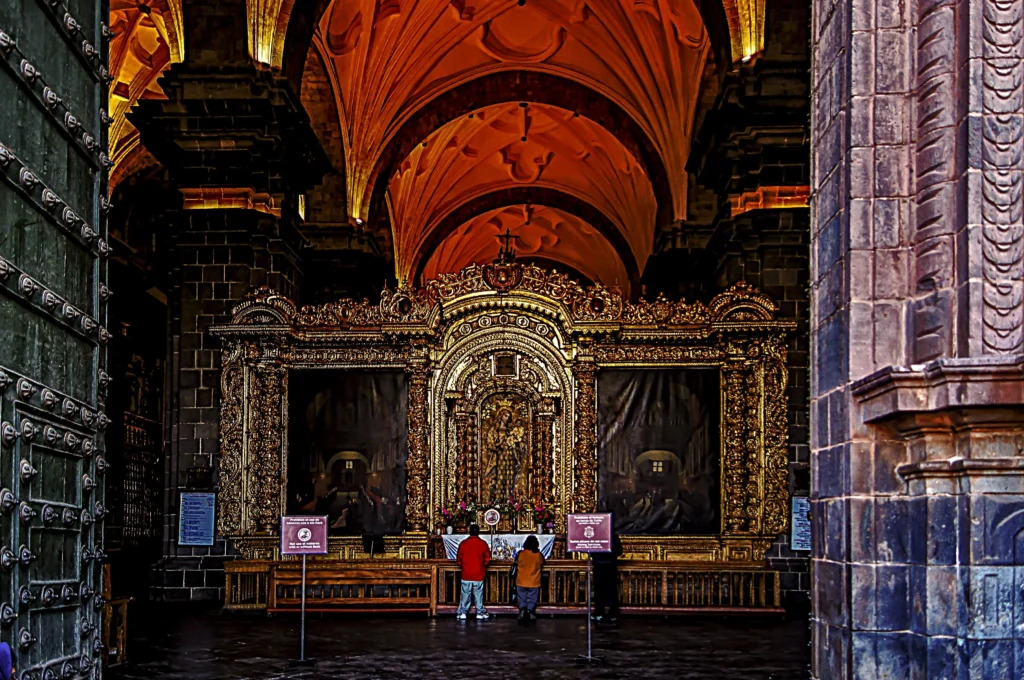
The Cusco Cathedral occupies one of the most prominent positions on the plaza. Its monumental façade and interior collection of colonial religious art make it one of the city’s most important attractions.
Construction developed over many years during the colonial period, and the cathedral contains artistic influences associated with different architectural traditions.
Inside, visitors can find paintings, sculptures, altars, religious objects, and examples of the famous Cusco School of painting.
Why visit the cathedral?
The cathedral is important for several reasons:
- Its prominent position on the Plaza de Armas.
- Its colonial architecture.
- Its religious significance.
- Its collection of colonial art.
- Its connection with the history of Cusco.
- Its examples of local artistic traditions.
Visitors interested in history should allow enough time to appreciate the interior rather than simply photographing the exterior.
Historic Buildings and Churches
The buildings surrounding the Plaza de Armas are among the finest examples of Cusco’s colonial architecture.
Church of the Society of Jesus
The Church of the Society of Jesus, commonly known as Compañía de Jesús, stands beside the cathedral and is one of the most impressive structures around the plaza.
Its ornate façade contrasts strongly with the simpler appearance of some surrounding buildings. The church also illustrates the importance of religious institutions in colonial Cusco.
Colonial arcades
The stone arcades surrounding the plaza are an important part of its visual identity. Many contain restaurants, cafés, stores, and businesses today.
These arcades also provide sheltered areas where visitors can sit and observe the activity of the square.
Historic streets surrounding the plaza
Don’t limit your visit to the open square itself. Some of the most interesting architecture begins immediately beyond the surrounding buildings.
Walk into the streets leading away from the plaza and look for carved stone doorways, balconies, Inca foundations, narrow passageways, and traditional architecture.
Plaza de Armas Cusco at Night
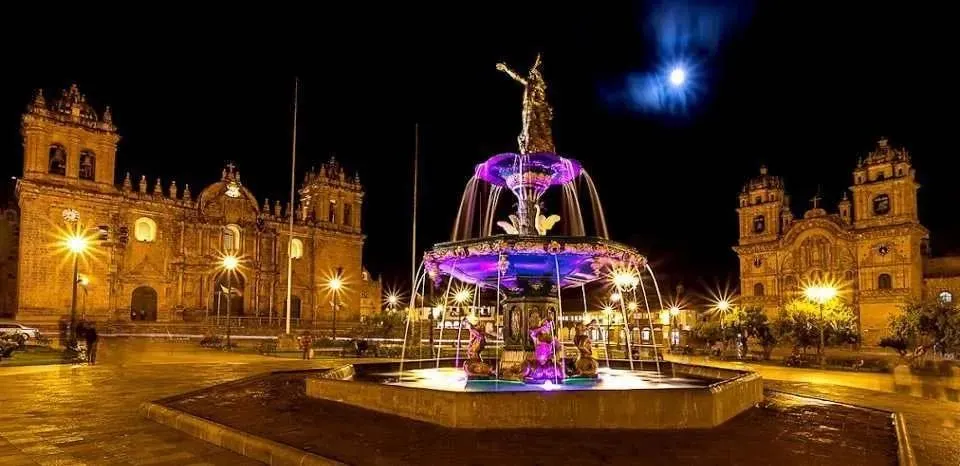
The Plaza de Armas Cusco at night offers a completely different experience from the daytime.
After sunset, the cathedral, churches, arcades, and surrounding buildings are illuminated. The central gardens and fountain become particularly atmospheric, while restaurants and cafés create a lively evening environment.
What makes the plaza special after dark?
At night, the crowds often change from daytime sightseeing groups to travelers having dinner, local residents meeting friends, and people enjoying the evening.
The illuminated architecture makes the square particularly attractive for photography.
A nighttime visit can also be a relaxing way to end a busy day of sightseeing. Instead of rushing between attractions, sit beneath the arcades, have a drink or meal, and watch the activity around the square.
Is it worth visiting at night?
Yes. If your schedule allows, seeing the Plaza de Armas both during the day and after dark is worthwhile because the atmosphere is noticeably different.
During the day, the focus tends to be on architecture and sightseeing. At night, the square becomes more atmospheric and social.
Things to Do Around Plaza de Armas Cusco
The plaza is ideally positioned for exploring some of the most popular attractions in central Cusco.
Walk to Hatun Rumiyoc
Hatun Rumiyoc is famous for its Inca stonework and the Twelve-Angled Stone. It can be reached on foot from the Plaza de Armas and is an essential stop for anyone interested in Inca architecture.
Take your time examining the wall rather than simply looking for the famous twelve-sided stone.
Explore San Blas
San Blas is one of Cusco’s most charming traditional neighborhoods. Its narrow streets, artisan workshops, galleries, and steep pathways make it an excellent continuation of a Plaza de Armas visit.
The neighborhood also provides elevated views across the city.
Visit Qorikancha
Qorikancha, the Temple of the Sun, provides one of the clearest examples of the relationship between Inca and Spanish colonial architecture.
The complex combines surviving Inca stonework with the colonial Santo Domingo complex.
Visit museums
The area around the historic center contains museums covering archaeology, colonial art, Peruvian culture, and Cusco’s history.
A museum visit can be especially useful before visiting archaeological sites outside the city because it provides historical context.
Explore San Pedro Market
San Pedro Market offers a more everyday view of Cusco. Travelers can browse food stalls, produce, local ingredients, traditional products, and souvenirs.
It is a useful addition for visitors who want to experience more than the city’s monuments.
Enjoy Peruvian food
The streets around the Plaza de Armas contain restaurants serving Peruvian and international cuisine.
Travelers can try traditional Andean dishes, Peruvian classics, desserts, coffee, and regional specialties.
Because the plaza is a major tourist area, prices and styles vary considerably, so exploring side streets can reveal different dining experiences.
Practical Information for Visitors
A successful visit to the Plaza de Armas does not require complicated planning, but a few practical considerations are important.
Best time to visit
The plaza can be visited throughout the year. Morning is often a good time for a quieter experience and photography, while afternoon provides more activity.
Evening is ideal for seeing the illuminated architecture.
Weather in Cusco can change quickly, so travelers should be prepared for both sun and rain depending on the season.
How long should you spend at Plaza de Armas Cusco?
You can see the square itself in less than an hour, but that would miss much of what makes the area interesting.
For a more complete experience, plan approximately two to four hours if you intend to visit the cathedral, explore nearby streets, take photographs, and stop for food or coffee.
If you combine the plaza with Qorikancha, San Blas, museums, and other attractions, you can easily dedicate most of a day to the area.
What should you bring?
For a walking visit, consider carrying:
- Comfortable walking shoes.
- Sun protection.
- A light jacket.
- Rain protection during wetter periods.
- Water.
- A small camera or smartphone.
- Some local currency.
- Personal identification when required.
- A small backpack rather than bulky luggage.
Altitude considerations
Cusco is located at high altitude, and visitors arriving from lower elevations may need time to adjust.
Do not underestimate the effort involved in walking through the historic center. Even relatively short routes can feel demanding, especially when climbing toward San Blas.
During your first day, consider taking a slower pace and allowing time for rest.
Photography etiquette
The Plaza de Armas is an excellent place for photography, but visitors should be respectful around churches and religious ceremonies.
Some interiors may have restrictions on photography. Always follow posted instructions and local guidance.
A Suggested Plaza de Armas Cusco Walking Route
If you want to experience the area efficiently, a logical walking route can begin and end at the plaza.
Morning
Start at the Plaza de Armas and photograph the fountain, cathedral, arcades, and surrounding churches.
Enter the cathedral if it is open and then explore the streets around the square.
Late morning
Walk toward Hatun Rumiyoc and examine the Inca walls before continuing toward San Blas.
Lunch
Return toward the central area or choose a restaurant in San Blas.
Afternoon
Visit Qorikancha or a museum, depending on your interests. Leave enough time to explore the surrounding streets rather than rushing from one attraction to another.
Evening
Return to the Plaza de Armas after sunset. See the illuminated cathedral and churches, then enjoy dinner in the historic center.
This itinerary provides a balance of Inca history, colonial architecture, local culture, food, photography, and modern Cusco.
Why Plaza de Armas Cusco Is So Important
The Plaza de Armas is one of those rare places where several centuries of history remain visible in a relatively small area.
Its significance comes from the way the past and present coexist. The square was important during the Inca period, was transformed during Spanish colonial rule, and continues to serve as the center of social and cultural life in modern Cusco.
For travelers, it also provides an excellent introduction to the city. From one location, you can immediately see colonial churches, traditional architecture, Inca foundations, historic arcades, and streets leading toward important neighborhoods.
The square therefore works both as a destination and as a gateway to the wider Cusco Historic Center.
FAQ About Plaza de Armas Cusco
What is Plaza de Armas Cusco famous for?
Plaza de Armas Cusco is famous for its historical importance, colonial architecture, central fountain, Cusco Cathedral, Church of the Society of Jesus, and its connection to the ancient Inca capital.
Where is Plaza de Armas Cusco located?
It is located in the center of Cusco’s Historic Center in southeastern Peru. It is surrounded by major historic buildings and is within walking distance of many of the city’s principal attractions.
What was Plaza de Armas Cusco used for during the Inca period?
The area formed part of a much larger ceremonial and political space in the Inca capital. Important public, religious, and political activities took place in and around the ancient plaza.
What can you see at Plaza de Armas Cusco?
Major sights include the central fountain and statue, Cusco Cathedral, Compañía de Jesús, colonial arcades, historic buildings, and the surrounding streets containing Inca walls and foundations.
Is Plaza de Armas Cusco free to visit?
Walking around the public square itself does not require an entrance ticket. However, individual attractions around the plaza, such as museums or religious monuments, may have their own admission requirements.
Can you visit Plaza de Armas Cusco at night?
Yes. The square remains a popular place to visit after dark. The illuminated cathedral, churches, fountain, and surrounding colonial buildings create a particularly attractive atmosphere.
How far is Plaza de Armas Cusco from the airport?
The airport is relatively close to central Cusco. A taxi or private vehicle can generally reach the historic center in around 15–30 minutes, depending on traffic and the exact destination.
How long should you spend at Plaza de Armas Cusco?
Allow at least one to two hours to appreciate the square and its immediate surroundings. If you want to visit the cathedral, churches, museums, nearby Inca sites, and San Blas, you can easily spend half a day or more.
Is Plaza de Armas Cusco safe for tourists?
It is one of the busiest and most visited areas of Cusco. As with any crowded tourist destination, travelers should remain aware of their belongings and use normal precautions, particularly during busy periods.
Is Plaza de Armas Cusco worth visiting?
Absolutely. For first-time visitors, the Plaza de Armas is one of the essential places to see in Cusco because it combines Inca history, colonial architecture, religious art, local culture, restaurants, and access to many other attractions.
What is the best time to visit Plaza de Armas Cusco?
Morning is useful for a quieter experience and photography, afternoon is lively, and evening is excellent for illuminated architecture. Visiting at two different times of day provides a more complete experience.
What attractions are near Plaza de Armas Cusco?
Several major attractions are nearby, including Cusco Cathedral, Compañía de Jesús, Hatun Rumiyoc, the Twelve-Angled Stone, Qorikancha, San Blas, museums, San Pedro Market, and numerous historic streets.
Final Thoughts
The Plaza de Armas Cusco is more than the central square of a historic city. It is a place where the story of Cusco can be experienced through architecture, religion, public life, and the remains of the ancient Inca capital.
From the central fountain and magnificent cathedral to the surrounding colonial arcades and Inca stonework, almost every part of the square connects to a larger chapter of Peruvian history.
For travelers visiting Cusco, the best approach is not simply to arrive, take a photograph, and leave. Spend time sitting in the plaza, explore the surrounding streets, visit its historic churches, walk toward San Blas or Qorikancha, try local food, and return after dark to experience another side of this remarkable place.
The Plaza de Armas is the perfect starting point for discovering Cusco—and one of the places where the city’s extraordinary past and vibrant present come together most clearly.
Leave a Reply